Key takeaways
- An annual gas installation and chimney inspection is mandatory by law — under Article 62 of the Construction Law. Missing the inspection can mean a fine or the insurer refusing to pay on a claim.
- A gas boiler without an annual service uses 10–20% more gas because of accumulated deposits and contamination (Vaillant, service guide, 2024) (Vaillant technical data — independent confirmation: NFOŚiGW boiler efficiency reports).
- Most boiler and heat pump manufacturers require an annual service as a warranty condition — without it, repairs are entirely on you.
- Typical yearly service costs for a home are PLN 700–1,300 in total. The first major failure from a neglected boiler costs more.
A letter from the housing community is a good day
A letter from the housing community is actually good news. It means someone on behalf of the building tracks the dates and let you know before something serious happened. Worse when there's no community — when you own a detached house, the gas installation, boiler, chimney and heat pump are entirely your responsibility, and no reminders will arrive.
Technical inspections are one of those home duties that are invisible while everything works — and very visible when something breaks or a check from the fire service or insurer finds a gap. It's not just paperwork. It's money and safety.
Conversations with Polish homeowners while designing Homeward showed a clear pattern: nearly everyone knew they "should call the chimney sweep" or "organise a boiler service". Almost nobody knew when the last one was, who did it, or whether there's any documentation. That's why seasons matter practically in Homeward: not as decoration but as context for reminders and tasks that should appear before the nervous search for a technician starts.
What does the law say about home inspections?
Polish construction law places specific obligations on owners and managers of properties. These are not recommendations — they are requirements whose breach may result in a fine or liability for damages (Article 62 of the Construction Law, Journal of Laws 1994 no. 89 item 414, as amended).
Mandatory yearly:
- Gas installation and flue ducts — tightness, patency, technical condition
- Chimney installation (smoke, flue and ventilation ducts) — chimney sweep inspection
- Building elements exposed to harmful atmospheric influence
Mandatory every 5 years:
- Technical and aesthetic condition of the building
- Electrical and lightning installation — measurements, insulation condition, protection effectiveness
Outside the law — manufacturer warranty conditions:
Most boiler manufacturers (Viessmann, Vaillant, Bosch, De Dietrich) and heat pump manufacturers (Daikin, Mitsubishi, LG, Panasonic) require an annual service by an authorised point as a warranty condition. No documented inspection = no warranty = repairs out of your own pocket.
And critically: home insurance. Many policies exclude damage caused by neglecting mandatory inspections. A fire from the chimney after 3 years without a chimney sweep inspection — the insurer can refuse to pay, citing breach of the owner's duties (KNF, insurance market, 2024). While you're at it, also check whether your home policy is still valid — these two issues are linked.
What happens when you neglect the service?
Before we get to organisation — what does it really cost? Two kinds of cost: visible and hidden.
The visible cost is the emergency repair that would happen less often, or not at all, with regular service. A gas boiler with accumulated deposits works harder, loses efficiency and needs parts more often. Typical cost of a boiler repair after several years without service: PLN 800–2,000 (indicative technician rates, 2025).
The hidden cost is higher energy bills throughout the period of neglect. A gas boiler without an annual service uses 10–20% more gas because of heat exchanger dirt and burner deposits (Vaillant, service guide, 2024) (Vaillant technical data — independent confirmation: NFOŚiGW boiler efficiency reports). At a PLN 4,000/year heating bill that's PLN 400–800 wasted every year.
Air conditioning without regular filter cleaning and refrigerant level checks: 10–15% higher electricity use and shorter compressor lifespan — and a compressor replacement costs PLN 1,500–3,000.
Total: PLN 900–1,600 a year on all inspections in a home with a gas boiler and air conditioning. Sounds like a lot? The first emergency technician visit outside hours, to a boiler that stopped heating in February, is PLN 300–500 for diagnostics alone.
An annual gas boiler service at an authorised service point costs PLN 200–350 in Poland and is required by most manufacturers to keep the warranty valid. A neglected boiler uses 10–20% more gas — which at an average heating bill translates into PLN 400–800 wasted yearly (Vaillant, 2024) (Vaillant technical data — independent confirmation: NFOŚiGW boiler efficiency reports).
Heat pumps and air conditioning — newer units, same rules
Many Polish homes today have a heat pump or air conditioning installed in the last 5–10 years. A newer unit, so somehow "not associated with a chimney sweep or service". Meanwhile the rules are identical to a boiler.
Heat pump — service every year or every two heating seasons (depending on the manufacturer). Scope: refrigerant pressure check, exchanger cleanliness, filter condition, controller parameters. Manufacturers like Daikin, Mitsubishi Electric or LG explicitly write this into the warranty terms — no service documentation = claim rejected.
Air conditioning — service 1–2 times a year (before summer and/or winter). Filter cleaning you can do yourself (every 1–2 months). Once a year it's worth asking a specialist to check the refrigerant and do deeper cleaning. AC that wrings moisture and circulates air is an ideal environment for bacteria and mould when the filter is dirty.
Note an asymmetry: cooling AC feels like a "seasonal" unit and many owners neglect service in winter. Meanwhile most modern split units also work as heat pumps for heating — they're used intensively in winter, and a post-winter service matters more than a pre-summer one.
Mechanical ventilation with heat recovery (recuperator) is a separate category. Filters need replacing every 3–6 months, the heat exchanger — cleaning once a year. A dirty recuperator not only loses efficiency — it can become a source of air contamination in the home.
How to track all this without relying on memory?
The common denominator across all these inspections is one thing: dates. Boiler: October. Chimney sweep: September. AC: May and September. Heat pump: April. Electrical: every 5 years from the previous.
Without a system — you rely on it "somehow sorting itself out". With a system — every inspection is planned several weeks ahead, you have time to find a technician, compare offers and book a slot when it suits you, not when something breaks.
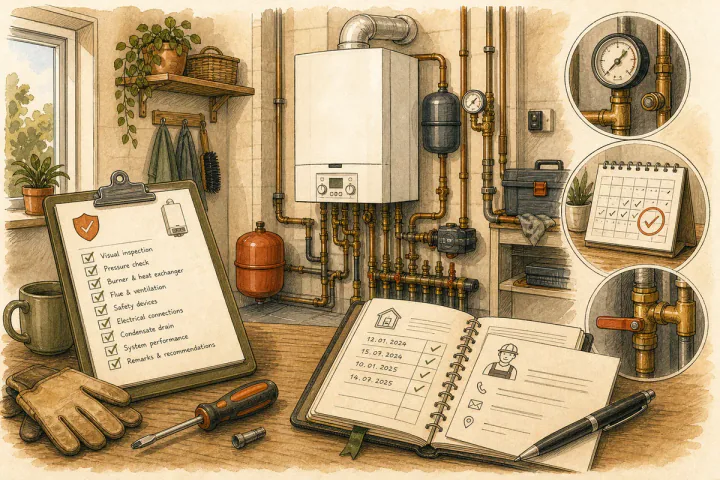
What to keep for each device:
- Date of last inspection and the service name
- Device serial number (to report to manufacturer/service)
- Inspection report or confirmation
- Contact details of the technician you used
- Reminder 4–6 weeks before the planned date
Four weeks of lead time is no accident. A good boiler technician in October often has slots booked from September. If you call in November with "no hot water" — you may wait.
A note on the fridge and a calendar reminder say: "book the service". They don't tell the technician which boiler model you have, when the last inspection was, or what the previous technician noted in the report. Homeward keeps these together: device serial, purchase date, inspection history with reports and a reminder set 4–6 weeks ahead — before technicians' calendars fill up. Homeward is in pre-launch — you can join the waitlist for free.
Regardless of the chosen system, what matters is one decision: that inspection dates go into the calendar ahead of time, not after a failure.
Frequently asked questions about home technical inspections
Is a chimney inspection really mandatory?
Yes, under Article 62(1)(1) of the Construction Law. It applies to owners and managers of all buildings, regardless of area. A chimney inspection of flue and smoke ducts must be performed at least once a year. Failure to do so may result in a fine and the insurer refusing to pay out after a fire (Construction Law, Art. 62).
Who can perform a gas installation inspection?
A gas installation inspection must be performed by a qualified person — a master chimney sweep or a person holding qualifications to service gas installations. It can't be a random handyman. When choosing a technician, ask for proof of qualifications and ask for a written inspection report.
Does the boiler manufacturer require an annual service?
Yes — most reputable manufacturers (Viessmann, Vaillant, Bosch, De Dietrich, Junkers). Warranty conditions explicitly state that an annual service by an authorised point is required to keep the warranty in force. No service documentation = grounds for refusing a warranty repair. Always check your boiler's warranty terms after purchase. The same rule applies to other home appliance warranties — service documentation is a condition for protection.
How often should I service a heat pump?
Heat pump manufacturers (Daikin, Mitsubishi, LG, Panasonic, Viessmann) typically require service every year or every two years, depending on the model and intensity of use. The scope includes checking refrigerant pressure, exchanger and filter condition and controller calibration. Neglect voids the warranty — and a heat pump is a PLN 20,000–50,000 investment.
What should I receive after a boiler or chimney inspection?
After every inspection you should receive a report or certificate in writing with the date, scope of work, technical condition found, and details of the person performing the inspection (name, surname, qualifications or registry number). That document is the basis for a complaint and the proof at an audit or insurance claim. Don't accept "verbal confirmation".
Checklist: home technical inspections — what and when
- [ ] Gas boiler — annual service by an authorised point (best in September–October)
- [ ] Gas installation — annual tightness and condition check
- [ ] Chimney ducts — annual chimney sweep inspection (legally required)
- [ ] Heat pump — service per manufacturer requirements (usually yearly)
- [ ] Air conditioning — service 1–2 times a year, filters every 1–2 months
- [ ] Recuperator (if installed) — filter change every 3–6 months, annual service
- [ ] Electrical installation — measurements every 5 years (legally required)
- [ ] For every inspection: keep the report with date and technician details
The cost of planned inspections is a fraction of what a mid-season failure costs. Other silent home costs — standby, dripping taps, outdated appliances — give similar savings with even less effort.