Key takeaways
- A setting with visible, unfixed faults creates a constant background tension for the household — the brain registers every open fault as an unclosed task loop, even if we don't think about it consciously.
- One accent wall delivers ~80% of the visual effect of a renovated room at 25% of the work compared with painting the whole space (indicative data from Dulux — manufacturer statement, dulux.com, 2023).
- Realistic scope for one weekend: 3–5 small repairs, 1 visual project (painting or rearranging), 1 outdoor space — provided the list and shopping are ready on Friday.
- A summer reset isn't a renovation. It's closing the backlog that builds up over a year — before it grows into real problems.
Why does the "summer reset" work better than yet another renovation list?
Most home plans die on Saturday morning, when it turns out the materials are missing, the scope has grown from "freshening up the living room" to "maybe while we're at it I'll change the bathroom tiles too", and the time goes on a drive to the DIY store. The summer reset works differently — because it's built on a limit, not on ambition.
The rule is simple: you have two days, a clear list, a set budget and time only for what you see every day. Summer also brings practical benefits: long days, open windows shorten paint drying time, and temperatures above 15°C are optimal for most finishing materials.
While designing Homeward, we talked to homeowners about how they approach home backlogs. The pattern was always the same: the repair list grows for a year, then either lands in a drawer, or someone takes on one item — and for a few weeks things feel better. "Summer reset" also captures the way of thinking we want in Homeward: not a grand plan to improve all of life, just a few sensible things to do exactly in this season.
What to do on Friday evening, before you pick up the brush?
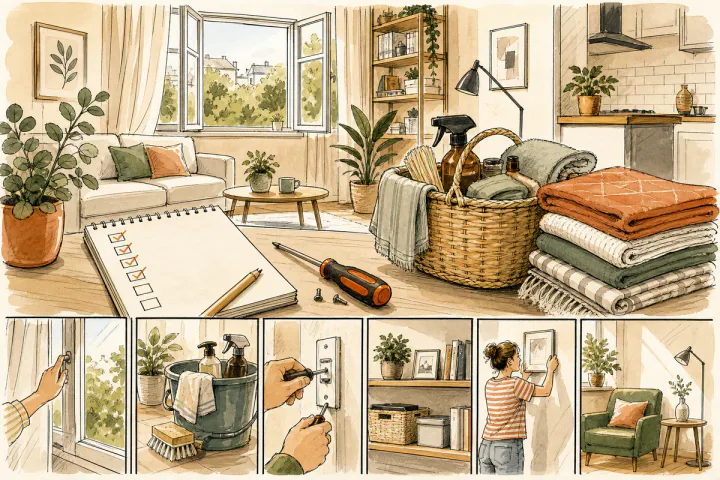
The most important rule of a weekend reset: list on Friday, shopping on Friday, start Saturday morning. Every Saturday hour spent at the DIY store is one fewer hour for the work — and you usually come back with two things you didn't need and without the one you did.
How to build the list? Walk through the home and write down everything that irritates you. Don't filter — just take notes. Then split into three columns:
| Under 30 min | Takes 2–4h | Takes longer |
|---|---|---|
| Oil the hinges | Paint a wall | Replace a window |
| Tighten the handle | Move furniture | Renovate the bathroom |
| Re-seal the bath | Tidy the balcony | Replace the floor |
Column one is your weekend. Column two is at most one project across the two days. Column three — for another time, with a separate plan. If anything in column three concerns the bathroom or installations, start with the plan and budget before you touch anything.
How much can you realistically get done? One weekend = 3–5 small repairs + 1 medium project + 1 outdoor space. No more. A list that fits in a weekend is a list that actually gets done.
Which small repairs are worth starting on Saturday morning?
Squeaky hinges, a loose bedroom handle, chipped sealant by the bath, a crack in the plaster behind the couch. Each of those is trivial on its own. Together they create a "neglect" background that we register subconsciously every day — even if we don't analyse it.
Visible, unfixed small faults create a constant quiet noise in the background. The brain processes every open task as an unfinished loop — and it does that non-stop, even if we don't think about it consciously. Closing five such items in one Saturday morning changes the feel of the whole flat more than the sum of the individual repairs would suggest.
Typical small repairs and realistic time:
| Repair | Time | Material cost |
|---|---|---|
| Oiling hinges (5–10 doors) | 15 min | PLN 5–10 (WD-40) |
| Tightening loose handles | 20 min | PLN 0 |
| Filling a crack in plaster | 30 min | PLN 15–25 (filler) |
| Replacing bath sealant | 45–90 min | PLN 20–40 (silicone) |
| Tightening kitchen cabinet fronts | 15 min | PLN 0 |
| Replacing a damaged socket | 20 min | PLN 15–30 |
Source: Homeward editorial estimate based on OBI/Castorama prices, 2025
Total: 2.5–3.5 hours and PLN 55–105. Result: the flat stops "creaking" — literally and metaphorically.
It's worth starting with small repairs rather than painting or rearranging. Small repairs are finished and closed — they give a sense of progress that powers the rest of the work. A wall mid-paint is several hours of chaos. Five closed small tasks are five items crossed off the list.
Visible, unfixed small faults — squeaky hinges, loose handles, chipped sealant — create a constant quiet noise for the household. Every open fault is an unclosed loop the mind keeps processing in the background. Closing 5–6 such items in one Saturday morning changes the feel of the whole flat more than the sum of the individual repairs would suggest.
Why does one wall do more than a whole room?
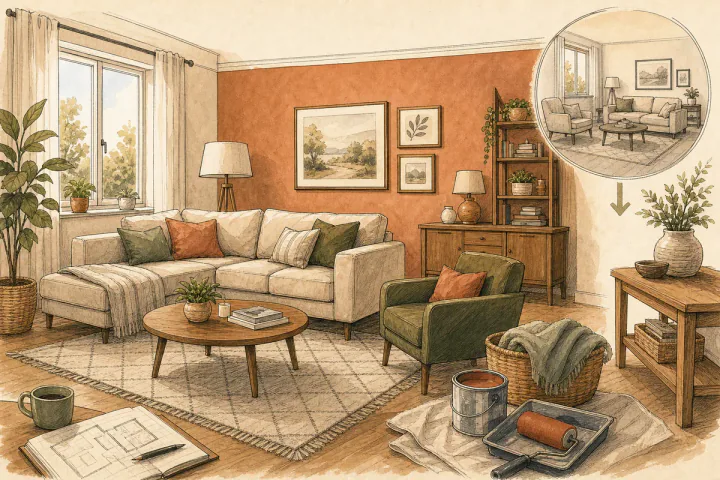
One painted accent wall delivers ~80% of the visual effect of a renovated room at a fraction of the work compared with painting the whole space (indicative data from Dulux — manufacturer statement, dulux.com, 2023). This rule works especially well behind the couch, behind the bed, or by the entrance.
When a thorough wall wash is enough:
- The wall has good colour but is grey from dust and finger marks
- Hallway, kitchen — greasy traces but no discolouration
- A wall cleaner + sponge is 30 minutes and no mess
When it's worth painting:
- Visible stains, deeper scratches, or the old colour doesn't fit
- You want a real mood change in the room
- The wall has cracks — filling first, paint second
Summer colours — practical tips:
| Room | Shades | Effect |
|---|---|---|
| Bedroom | Cool blues, sage, light beige | Visual cooling, better sleep |
| Living room | Warm whites, cream, terracotta | Sense of space and warm light |
| Kitchen | Light green, cream white | Freshness, nature link |
| Hallway | Graphite, bottle green | Contrast, entrance with character |
Source: Dulux colour guidance, Farby Dekoral, 2025
Painting one wall (3×2.5 m): 1.5–2.5 hours including prep and two coats. Summer = open windows = drying faster than 2h between coats.
How to reclaim space without buying anything new?
Rearranging furniture and removing what you really don't use changes a room more than a new piece — and costs zero zloty.
The 3-box method:
- Keep — used at least once a month, fits naturally
- Donate / sell — good condition but not used; OLX or a collection point
- Throw away — worn out, broken, duplicated
Time: 2–3 hours per room with a wardrobe. Result: freed shelves = space that "breathes".
Rearranging without tools:
Before you buy anything, check whether the furniture layout is really optimal. The most common mistakes:
- Couch under the window — blocks natural light instead of letting it in
- Desk back to the window — light source behind the monitor tires the eyes
- Bed by the AC vent or the door — worsens sleep quality
Moving one piece takes 10–20 minutes. A thoughtful new layout does more for the sense of space than a new sofa.
What to do with the balcony and garden in one afternoon?

Balconies and gardens are the spaces that drift fastest into neglect over winter and return fastest to form in summer. One Sunday afternoon is enough.
Balcony list (2–3 hours):
- Wash floor and railing
- Check outdoor furniture — condition, does it need treating
- Take out everything that's been there "temporarily" since autumn
- 2–3 pots: geraniums, lavender, herbs — PLN 40–80
- Check window and door seals on the balcony side
Garden list (3–4 hours):
- Prune hedge and shrubs after winter
- Mulch the beds before summer heat
- Check irrigation system — joint tightness
- Clean the paving or terrace — brush with detergent or pressure washer
- Inspect pergola or gazebo — wood condition, loose elements
It's also worth checking gutters and downspouts. That's one of the classic silent home costs: a leaking gutter for one season is PLN 50–200 in repair, three seasons in — several thousand zlotys inside the wall.
What to buy before the summer reset so you don't make three store runs?
One trip to the DIY store on Friday evening is worth as much as two unplanned ones on Saturday morning. According to Statistics Poland, Poland has more than 2,400 large retail outlets with construction and finishing supplies (Statistics Poland, Domestic trade in Poland 2023, 2024). Most carry the same products at comparable prices. The key isn't the shop, it's the list.
Based on the typical weekend resets that homeowners described in Homeward's pre-launch research, we built a shopping list that handles 80–90% of a typical reset without extra trips (own Homeward survey, pre-launch, N=150, 2025).
Base list — for every summer reset:
| Product | Use | Indicative price |
|---|---|---|
| WD-40 or hinge oil (400 ml) | Hinges, locks, runners | PLN 15–25 |
| White wall filler (1 kg) | Cracks in plaster, defects | PLN 10–18 |
| Sanitary silicone white or clear | Sealing bath, shower tray | PLN 15–30 |
| Painter's tape (25 mm, 50 m) | Protect trim before painting | PLN 8–15 |
| Interior paint (1 litre, colour test) | Small accent wall | PLN 20–60 |
| Sandpaper (P80, P120, P220 set) | Sanding before painting | PLN 8–20 |
| Wall cleaner (500 ml spray) | Washing walls before painting | PLN 12–20 |
| Work gloves (pair) | General work | PLN 8–15 |
Source: Homeward editorial estimate based on OBI/Castorama/Leroy Merlin prices, 2025
Extended list — if you plan to paint:
Add to the above:
- Roller with handle and tray (PLN 15–30)
- 50 mm brush for edges and trim (PLN 8–15)
- Painter's plastic or newspapers to cover the floor
- Surface degreaser (spray, if painting a kitchen or bathroom wall)
List for balcony or garden:
- Outdoor wood preservative (if you have wooden furniture or pergola)
- Detergent for paving or terrace
- 2–3 pots with soil and seedlings or seeds
Before you go shopping: check what you already have. Most households have WD-40, painter's tape and paint leftovers from the last job. Note your stock and only buy what's missing. That halves the Friday shopping list.
How do you record the work in your home history?
A summer reset is also a good moment to top up the home history. Every repair, replacement and refresh you leave without a trace disappears from memory within a year. In three years' time you won't know when the bath sealant was last replaced or when you painted the living room. The buyer, technician or insurer won't know any better.
Repair history is one of the most under-appreciated assets a homeowner has. The RICS report points out that a documented service and renovation history of a property has a positive effect on valuation and shortens time to sale (RICS, Residential Property Standards, 2023). In Poland this habit is only just forming, but anyone who's tried to sell a flat without renovation history knows how hard it is to answer the buyer's "when was the boiler replaced?" or "did this wall ever have moisture problems?"
What's worth writing down after each reset?
Minimum record for each repair:
- Date completed
- What was done (1–2 sentences)
- Who did it: yourself or a firm (name)
- Cost of materials and labour
- Documents on hand: invoice, receipt, warranty card
A note like that takes 2 minutes. In five years' time you'll have a complete home history, accessible in 30 seconds.
How to do this simply:
Sounds simple — and it is, as long as you remember where you saved it. The Excel from the previous renovation is on a laptop you gave back. The phone note vanished after a system update. The paper notebook is somewhere with invoices from 2022. Three years later, the question "when did you last replace the sealant?" has no answer — even though you carefully wrote it down.
This is exactly the problem we designed the Home Passport in Homeward for: one entry from a phone (date, description, photo, cost), tied to a specific room and element, always available in the same place. You don't make a template, you don't worry about backups, you don't search across three apps. Service and repair history is where you need it — when you call the technician, talk to the insurer or prepare for a sale.
Homeward is in pre-launch — if you want the Home Passport ready for the next reset, you can join the waitlist for free.
Example entry:
`` 2026-06-08 | Bath and shower tray sealant replacement | DIY | Ceresit white silicone, PLN 28 | No invoice (receipt) ``
What else is worth recording after the weekend:
- Paint colours used with the manufacturer's code — useful for touch-ups, no need to guess
- Dimensions of the trim or tile you bought — in case you need more later
- "Before and after" photos — two phone shots, labelled with date and location
"Before" photos are an especially valuable asset. They show the state of the wall, floor or installation at a precise moment. If a damp issue or crack shows up a year later, the photo from before the repair gives context — is this new, or has it been building up?
Frequently asked questions
How much can you actually get done in one weekend?
Realistically: 3–5 small repairs (2–3 hours total), one visual change (painting a wall or moving furniture, 3–4 hours) and refreshing one outdoor space (2–3 hours). The key: list ready on Friday, materials bought on Friday, start Saturday morning.
Where to start if everything feels neglected?
Start with the room you use most — usually the living room or kitchen. A visible result where you spend the most time gives the biggest return on the work. Don't start with the basement or the wardrobe — those are projects with no clear end that eat a whole weekend without a visible result.
Should I paint myself or hire a painter?
One accent wall — do it yourself, no question. A whole room with ceiling and recesses: a typical painter charges PLN 20–40/m² with materials, PLN 12–18/m² for labour only. For a 20 m² room (about 60 m² of walls and ceiling) that's PLN 1,200–2,400. Doing it yourself: PLN 150–300 for materials + 8–12 hours of work.
How do I avoid scope creep over the weekend?
Write the scope on Friday and stick to it. If you notice something new on Saturday — write it on the "next time" list. Don't open new fronts mid-project. One project finished is worth more than three started.
What if the weekend reset uncovers a bigger problem?
Write it down and park it on a separate list — don't tackle it now. After the weekend, decide whether it's urgent or can wait. If you've hit something with installations or building structure, review the annual technical checks or start with step-by-step home thermal modernisation.
Checklist: summer home reset
Friday evening
- [ ] List of every irritating small thing — walk through every room
- [ ] List split: <30 min / 2–4h / for another time
- [ ] Shopping: paint (if painting), silicone, filler, WD-40
- [ ] Bags or boxes for items to donate and throw out
Saturday
- [ ] Small repairs from the list: hinges, handles, cracks, sealant
- [ ] One visual project: painting a wall or thorough cleaning
- [ ] 3-box method in one room
Sunday
- [ ] Rearrange — at least try a new layout
- [ ] Balcony / garden: wash, plants, check outdoor furniture
- [ ] Gutters and window seals — quick visual check
- [ ] "Next time" list — so new discoveries don't stop the Sunday finish
After the weekend
- [ ] Record every repair in the home history: date, description, cost — in Excel, notebook or Homeward if you want it always at hand
- [ ] Photograph "after" results — useful for the next reset and for selling
- [ ] Note the codes of any paint used