Key takeaways
- The bathroom is the most frequently renovated room in Poland (36% of mentions). A standard 5 m² renovation costs PLN 17,000–25,000 gross in 2026 (Murator.pl, 2026).
- Labour eats 50–60% of the whole budget. It's worth comparing a minimum of 3 quotes before hiring anyone.
- Waterproofing costs about PLN 660. Skipping it can end in a PLN 20,000 repair (Sanitmax.pl, 2024, indicative data).
- Plan a 15–20% reserve above budget. That's not caution — it's a statistical necessity.
Why is the bathroom the hardest room to renovate?
The bathroom is the only room where a few square metres bring together plumbing, electrics, ventilation and damp-prone finishes. A mistake in any one of these costs many times more than the same mistake in the living room. Re-running installations under already-laid tiles is one of the most common and most expensive renovation mistakes in Poland.
You're not alone. According to a CAWI survey by Gama Meble of 1,000 respondents across Poland's 10 largest cities, as many as 36% of Poles renovate the bathroom first, ahead of the kitchen (27%) and the bedroom (23%) (Inżynier Budownictwa, 2024). It's the most popular renovation in the country. And yet the most common mistakes still come from lack of a plan, not lack of skill.
Good preparation is 60% of success. The rest is correct execution and the right choice of contractor.
Step 1: Scope — what do you actually want to do?
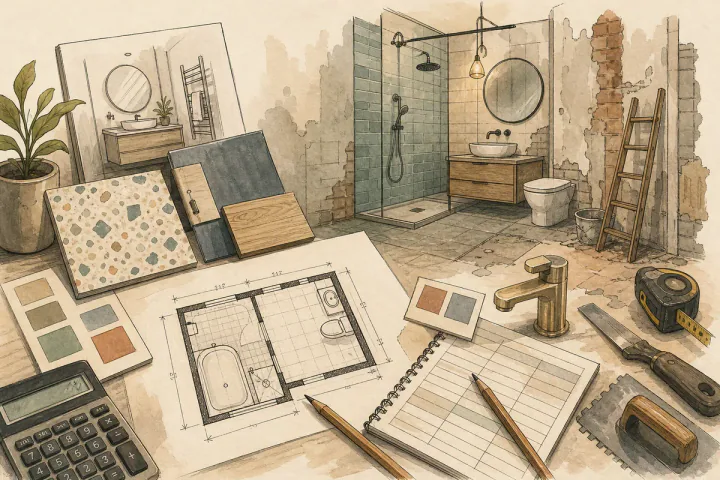
Before you call anyone, you have to know exactly what you want to do. As much as 20% of a renovation budget goes on hidden defects only revealed after old tiles come off — rusted pipes, crumbling mortar and so on (Rynek Pierwotny, 2025). The more precisely you define the scope before quoting, the more accurate the offer you'll get and the smaller the risk of nasty surprises.
Answer these questions before you call the first contractor:
- Are you replacing plumbing? (pipes, traps, connections under the new sanitary ware)
- Are you replacing electrics? (sockets, lighting, mechanical ventilation)
- Are you changing the layout or moving partition walls?
- Are you staying with the current sanitary positions, or moving them?
Every "yes" means an extra specialist and an extra cost. Every change in drain position means cutting concrete. Every change of mind after work has started costs 2–3 times more than the same decision taken at the planning stage.
Step 2: What does a bathroom renovation really cost in 2026?
A standard, comprehensive 5 m² bathroom renovation costs PLN 17,000–25,000 gross in 2026, of which materials are PLN 8,000–12,000 and labour PLN 9,000–13,000 (Murator.pl, 2026). Labour eats 50–60% of the whole budget. That's an important number: it means saving on materials gives a smaller effect than negotiating well with the contractor.
What else affects the price? In Warsaw and Krakow renovation service prices are 20–30% higher than in smaller cities (Leroy Merlin, 2026, indicative data). Trade rates rose 12–14% year on year due to the minimum wage and rising material costs.
Indicative price brackets (2026, Poland, installed prices):
| Standard | Cost per m² | Total cost 5 m² |
|---|---|---|
| Basic (budget tiles, standard ceramic) | PLN 1,200–1,800/m² | PLN 9,000–14,000 |
| Mid (premium tiles, branded fittings) | PLN 1,800–2,800/m² | PLN 14,000–21,000 |
| High (large-format tiles, premium fittings) | PLN 2,800–5,000+/m² | PLN 21,000–37,000+ |
Source: Murator.pl, Leroy Merlin, 2026
To the above add fixed costs, independent of floor area: electrical installation replacement (PLN 1,500–3,000), pipe replacement (PLN 1,500–4,000), ventilation (PLN 500–1,500).
Buffer rule: to every budget add 15–20%. Hidden damp behind tiles, rusty pipes, an old trap to replace — these come out only during the works. If the renovation involves a boiler change, insulation or windows — also check thermal-modernisation grants, which can cover part of the cost.
Step 3: The order of works you must not reverse
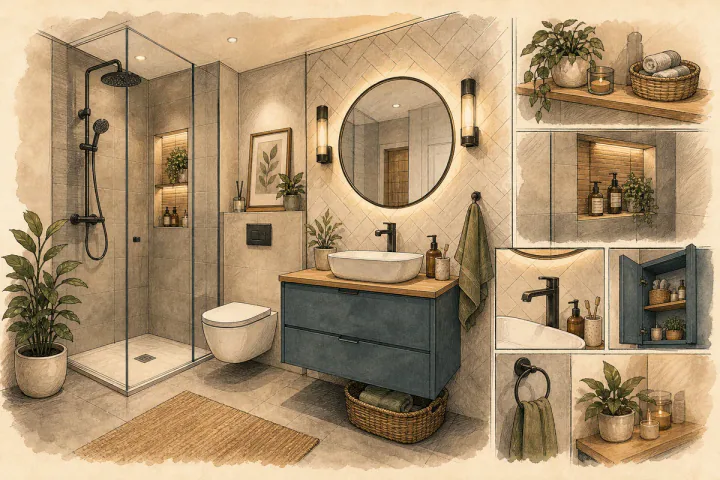
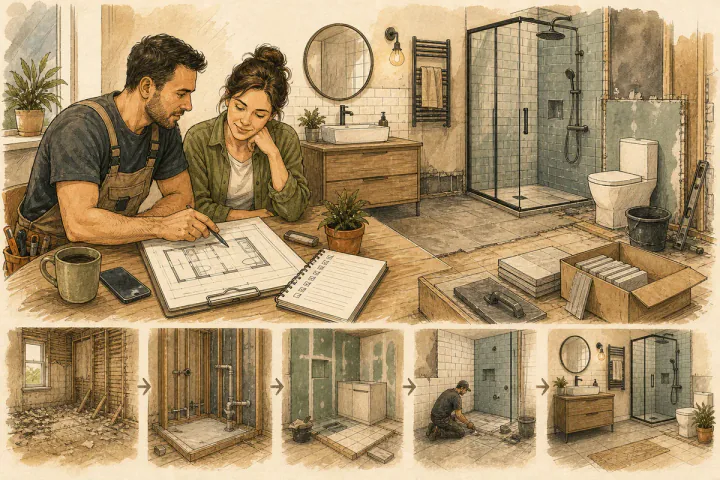
The order of works in a bathroom is strictly set by the technology. Changing it is a mistake that costs. There are no shortcuts. Each stage has to dry and harden before you start the next.
- Demolition — stripping old tiles, bath, sanitary ware, old installations
- Installations — plumbing and electrics (in that order, or in parallel)
- Plastering and screeds — wall levelling, floor screed with underfloor heating if planned
- Waterproofing — liquid membrane or sealing mat, mandatory at bath and shower
- Tiling — floor first, then walls (depending on the contractor's method)
- Grouting — minimum 48 hours after tiles are laid
- Sanitary ware install — bath or shower, toilet, washbasin
- Fittings install — taps, rain shower, accessories
- Lighting and doors — fixtures, mirror, doors if replaced
Don't install sanitary ware before grouting. Don't lay tiles before the plumbing. The rule is simple: installations before finishes, wet works before dry.
How long does it take? A small 4 m² bathroom is 2–3 weeks. A medium 6–8 m² is 3–4 weeks. A large one, over 10 m², is 4–6 weeks. Add 1–2 extra weeks for installation replacement (Homelux.pl, 2025, indicative data).
Step 4: How to find and check a good contractor?
94% of Poles hire professionals for a renovation. Only 6% do it themselves (Inżynier Budownictwa, 2024). Choosing the right person or crew is one of the most important decisions of the whole renovation. Because even the best tiles will look poor if poorly laid.
A bathroom is most often renovated by one foreman with a crew. Less often by a separate plumber and a separate tiler. What are the differences?
One crew end-to-end:
- Single point of contact, easier coordination
- Lower organisational cost
- Risk: good tiling doesn't always go hand in hand with good plumbing
Specialists separately:
- Better result in each area
- Harder scheduling between trades
- Higher organisational cost, but often higher final quality
How to check a contractor before signing?
- Ask for photos of previous jobs from their phone, not from stock
- Ask for references and actually call those people
- Check whether they issue VAT invoices (the basis for a complaint)
- Sign a contract with a work schedule and staged payments
Never pay the whole amount upfront. Standard scheme: 20–30% deposit at start, payments by stages as work progresses, 10% after final acceptance.
Step 5: What to buy yourself, what to leave to the contractor?
Tiles, fittings and sanitary ware are worth buying yourself. You have full control over taste and cost. Adhesives, grout and building materials — let the contractor buy them, or explicitly agree it in the contract. They glue with what they know and back it with the warranty on their work.
How many tiles to buy? The room area plus 10–15% for waste and cuts. For geometric patterns add 20%. Always order from a single production batch (the same lot number on the box). Shade differences between batches are the norm, not the exception.
Warranty on tiles: keep the invoices. Save a few from each series. If one cracks in 3 years' time, without an invoice and the batch number you won't fix it perfectly.
Waterproofing: the PLN 660 that can save you from a PLN 20,000 repair
This is the most important section of this article. Really.
A liquid membrane or sealing mat in wet zones costs about PLN 100–160 per m² in materials and labour. For a 5 m² bathroom that's about PLN 660 in total (Sanitmax.pl, 2024, indicative data). One day of work.
What happens without waterproofing? Water penetrates through leaks, migrates behind tiles, destroys the screed and walls. In an apartment block it reaches the neighbour below. Fixing such a situation, with replacing finishes, drying out and possibly compensation for the neighbour, costs PLN 15,000–20,000. Usually 5–8 years after the renovation.
Particularly important spots: the shower zone (especially walk-in showers without a tray), around the bath, the entire bathroom floor.
Waterproofing costs about PLN 660 for a standard 5 m² bathroom using a two-layer liquid membrane system. Skipping it is statistically the most common cause of serious water damage requiring a full renovation within 5–10 years of laying tiles (Sanitmax.pl, 2024).
Common mistakes that cost
85% of Poles had to change or delay renovation plans due to inflation and rising material costs (Gama Meble, CAWI, 2024). Some of those costs came from planning mistakes that only show up during or after the renovation.
No plan before the first hammer strike. Every change after work has started costs 2–3 times more than the same decision earlier. Bath or shower? Linear drain or point drain? Ask yourself these questions before day one, not in the middle.
No mechanical ventilation. Gravity isn't enough with airtight new windows. A fan with a humidistat that turns on automatically above a threshold is a PLN 300–600 investment. It eliminates damp and mould. No ventilation = mould on grout in 2–3 years.
Bad linear drain. A linear drain looks great but requires precise floor levelling toward the drain. A 1–2 mm error means puddles at every shower. Requires chipping out and redoing.
Too few sockets and light points. Minimum: socket by the mirror, socket for the hairdryer, lighting above the mirror and general. Better to plan one more now than chisel the wall after the renovation.
No photos of walls before they're sealed up. Installations, pipes, electrical boxes, exact position of every element behind the tiles. In 10 years' time, when you want to hang a cabinet, those photos can save your electrical system.
How to document a renovation so you don't regret it in 10 years?
A bathroom renovation is a 15–20 year investment. In that time you'll drill, fix, perhaps renovate again. Or sell the flat. In every one of those scenarios renovation documentation has real financial value.
What's worth doing during the renovation:
- Photograph walls and floors before each sealing-up (installations, pipes, boxes, waterproofing)
- Note all contractors with names, phone numbers and scope of work
- Collect invoices for every material and appliance. Each one is a potential warranty and proof at a complaint. How to keep home invoices in one place — in a separate article.
- Keep a few tiles from each series and note the batch number
- If the scope starts dangerously expanding, stop and break it into smaller stages. Sometimes it's better to first do a small summer home reset, and only then open a bigger renovation.
Renovation documentation is one element of the Home Passport in Homeward — a complete property history that grows with every job done. So after a year you still know what was sealed inside the wall, which materials you chose, who did the work and what's still under warranty. At sale, such a history is also an argument for a higher price — buyer and surveyor see not a promise but documents. Homeward is in pre-launch — you can join the waitlist for free.
Frequently asked questions about bathroom renovations
How much does a bathroom renovation cost in 2026?
A standard, comprehensive 5 m² bathroom renovation costs PLN 17,000–25,000 gross in 2026, of which labour is PLN 9,000–13,000 and materials PLN 8,000–12,000 (Murator.pl, 2026). In Warsaw and Krakow prices are 20–30% higher. When planning the budget, always add 15–20% reserve for surprises.
How long does a bathroom renovation take?
A small 4 m² bathroom is 2–3 weeks. A medium one, 6–8 m², is 3–4 weeks. A large one, over 10 m², is 4–6 weeks. Add 1–2 weeks if you're replacing plumbing or electrical installations (Homelux.pl, 2025, indicative data). Plan where you'll live during the work.
Is it worth doing a bathroom renovation yourself?
94% of Poles hire professionals to renovate a bathroom (Inżynier Budownictwa, 2024). With electrical and plumbing installations the qualification requirement is often both formal and practical. Tiling yourself is possible but mistakes are hard to fix. Always have waterproofing done by a specialist.
How do I keep within budget on a bathroom renovation?
Define the scope precisely before the first quote. Compare a minimum of 3 offers from different contractors. Add a 15–20% buffer to the planned amount. Don't change decisions after work has started. Every mid-project change costs 2–3 times more than the same decision made earlier.
Is bathroom waterproofing mandatory?
Legally — it depends on the building and the type of installation. Practically — yes, always. Waterproofing a 5 m² bathroom costs about PLN 660. Skipping it can end in a PLN 15,000–20,000 repair after a few years, and in a block of flats — additionally compensation for the neighbour below (Sanitmax.pl, 2024). It's one of the best returns on investment in the whole renovation.
Checklist: what to do before you start?
- Define the scope (installations, room layout, finish standard)
- Set the budget with a 15–20% buffer
- Gather a minimum of 3 quotes from different contractors
- Check references and sign a contract with staged payments
- Order tiles from a single production batch with a 10–15% reserve
- Confirm the contractor applies waterproofing in wet zones
- Plan where you'll live for the duration of the renovation
- Prepare a folder for invoices, photos and contact details of every contractor