Key takeaways
- An average Polish household generates 70–100 financial documents a year — bills, invoices, receipts, confirmations. Most land in at least 3 different places.
- The thermal-modernisation relief lets you deduct up to PLN 53,000 of expenses on a heat pump, solar PV or insulation from tax — but only with VAT invoices as evidence (Article 26h of the PIT Act, 2021).
- Tax documents and renovation invoices have to be kept for 5 years after the tax year. Most Poles don't know where they'll find them in 3 years' time.
- One folder with a clear structure is enough to stop searching for anything in four places at once.
You know the feeling
April. The tax deadline is approaching. Or the washing machine has died and you need the invoice to file a complaint. Or you're selling a flat and the buyer asks about the renovation history.
You start looking. Email with the solar panel invoice — maybe in old mail, maybe in spam. Receipt for the washing machine — maybe in that kitchen drawer, maybe in the plastic bag "for important things". Bank transfer confirmation for the plumber — maybe in the banking app, but maybe you paid by card. Invoice for the attic insulation from two years ago — absolutely no idea.
You lose an hour. Or two. Or you give up and hope it'll somehow be fine.
The problem isn't that you're disorganised. The problem is that financial documents land in many places by definition — because they have many senders and many forms. E-invoice for electricity goes to email. Receipt for the washing machine — into a coat pocket. Bank transfer confirmation — into bank history. No one synchronised this for you.
In Homeward's pre-launch survey we asked homeowners: "Where do you look for last year's renovation invoice?" The most common answers: email (74%), "different places, depends" (58%), physical binder (41%), banking app (39%). Almost 20% replied: "Honestly — I don't know and hope I won't need it" (own Homeward survey, pre-launch, N=150, methodology: online survey of potential users, 2025). That shows the core of the problem: a folder alone isn't enough if the document isn't later linked to the home, cost, appliance or renovation it concerns.
How many documents does one home generate in a year?
More than you think. For an average Polish household the yearly balance looks roughly like this:
Total: 75–100 documents a year. At every one of them the question is: where will it go? Email auto-archives e-invoices, but in 2 years' time you'll search by keyword and hope you remember it. A physical binder works if you actually keep it up. The banking app shows transfer confirmations but not seller invoices. The drawer catches the rest.
The result: after a year, every category of document has a different home. After two years — you already have 3–4 places for each category. After five — you're searching for something from 2022 and don't know whether you kept that email at all.
When a missing document really costs
A lost utility bill is mainly discomfort. But there are situations where a missing document means real money.
Thermal-modernisation relief — one of the most important tax arguments for document order. A single-family home owner can deduct up to PLN 53,000 of expenses on a heat pump, solar PV, wall insulation, boiler replacement and a dozen other categories from the taxable base (Article 26h of the PIT Act, 2021). The condition: VAT invoices issued to the owner. Without invoices — relief is gone. On a PLN 30,000 investment at a 12% tax rate — that's potentially PLN 3,600 in refunds you can lose for the want of a piece of paper.
Complaints and warranties — a receipt or invoice is the basic proof of purchase for a complaint. For appliances worth PLN 2,000–5,000, a missing document often means dropping the complaint, because the seller "cannot confirm the purchase". More on tracking home appliance warranties.
Selling the property — a complete history of invoices for renovations, investments and service is one of the arguments that lift the price. The buyer sees: bathroom renovation in 2023, boiler replacement in 2024, installation check here. Without documents — those are just words. Homeward designs the Home Passport for exactly this need: service, renovation and investment history gathered in one place, available at every conversation with a buyer, surveyor or insurer.
Tax inspection — for self-employment or PIT deductions, documents must be kept for 5 years from the end of the tax year. A missing invoice you claimed = obligation to return the relief with interest.
In Poland the thermal-modernisation relief lets you deduct up to PLN 53,000 of selected single-family-home energy modernisations — including a heat pump, solar PV and insulation — from the taxable base. The condition is having VAT invoices issued to the owner — without documents the tax office will not accept the deduction (Article 26h of the PIT Act, 2021).
How long do you have to keep home documents?
Before you start tidying up, it's worth knowing what you can't throw out.
| Document type | Required retention period |
|---|---|
| Tax documents, PIT, invoices for reliefs | 5 years from the end of the tax year |
| Renovation and service invoices | 5 years (thermal-modernisation relief), 2 years (warranty/guarantee) |
| Utility bills | 3 years (complaints, disputes with provider) |
| Receipts and invoices for appliances | For the warranty period + 1 year |
| Insurance documents | For the policy duration + 3 years |
| Property purchase contracts, mortgage | Indefinitely |
| Technical inspection reports | For the whole life of the property |
Source: Tax Ordinance, Consumer Rights Act, Construction Law
There's a non-obvious thing here: documents we have to keep longest are also the rarest to be issued and the easiest to lose. The flat purchase contract you have one — and you might only have it on paper from 2010. Renovation invoices with big deductions — a handful across the years. These documents in particular require a separate, durable place.
What happens when a warranty document is missing at the complaint?
A warranty document goes missing most often exactly when it's most needed. The appliance dies after 14 months. The warranty lasts 24. You look for the receipt — gone. You look for the invoice — you don't know if you bought online, by card in the store, or maybe through a company. The shop says: "without proof of purchase we can't process the complaint".
According to the Polish Office for Competition and Consumer Protection (UOKiK), the seller cannot refuse to process a complaint solely because of a missing receipt — but other proof of purchase must exist (UOKiK, Goods complaint, 2024). In practice this means: a card statement, transfer confirmation, order history in the shop's app or an email confirming purchase. Any of these documents may be enough — but only when you have it and know where to look.
The problem is that a card statement for a purchase 18 months ago doesn't contain the appliance name. Order history in an online shop is available, but only if you remember which shop you used. The email confirming the order may have gone to spam or to a mailbox you've since changed.
How to avoid this scenario? One simple habit: photograph the receipt or invoice immediately after purchase, with the device name and date in the file name. Takes 20 seconds. In two years' time, when the washing machine dies, those 20 seconds are worth several thousand zlotys.
How to name scanned files so you can find them?
The naming convention is more important than the folder. A file called scan0012.jpg is useless. A file called 2024-03-15_invoice_washing-machine-bosch_media-markt.pdf says everything. A simple rule:
`` YYYY-MM-DD_document-type_appliance-or-service_seller ``
A few examples:
| File name | What it contains |
|---|---|
2024-03-15_invoice_washing-machine-bosch_media-markt.pdf | Washing machine invoice, purchase date and shop in the name |
2024-07-02_receipt_dishwasher-whirlpool_rtv-euro-agd.pdf | Receipt — enough that it's saved with date and description |
2023-11-28_warranty_boiler-worcester_abc-service.pdf | Boiler warranty card with the technician |
2024-06-10_invoice_balcony-sealing_jan-kowalski.pdf | Invoice for renovation service with contractor |
The date at the start sorts files chronologically without any extra effort. The appliance or service description lets you find the document via system search without remembering the folder. The seller or contractor name helps when you're looking for a specific firm.
You don't have to rename old files at once. Start from today: every new document — a simple, descriptive name. In a year's time you'll have an archive you can actually search.
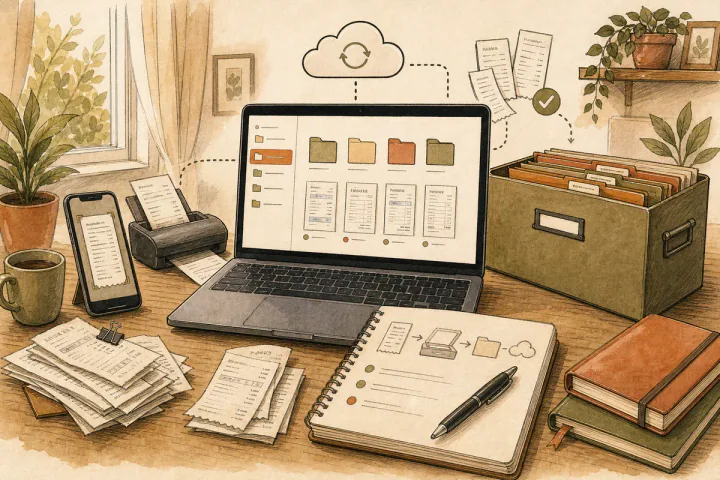
How do you organise documents in one place?
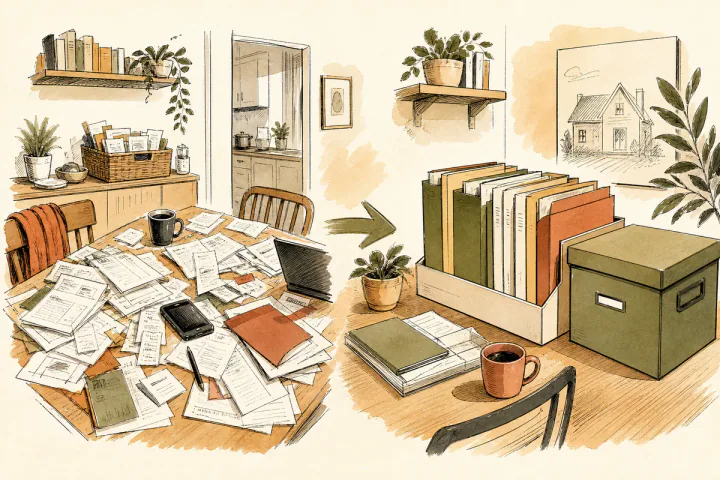
The system doesn't need to be complicated — it needs to be consistent. Everything in one place, clear structure, accessible in 30 seconds.
Digital folder — the simplest solution:
One main folder: "Home — documents". Inside, subfolders: Utilities and services, Renovations and service, Appliances and warranties, Insurance, Tax and finance, Contracts and property.
For each document: a name with a date (2025-04-12_invoice_plumber.pdf). The date in the name sorts files chronologically with no effort.
E-invoices from email: set a filter on keywords (invoice, bill, FV) and auto-move them into a tagged folder. Once a quarter: browse, download as PDF, add to the main folder.
Paper receipts: phone photo straight after purchase. A scanner app (Google PhotoScan, Adobe Scan) gives better quality than a plain photo. Paper receipts fade after 2–3 years — the digital copy stays.
Disk or cloud: Google Drive, OneDrive, iCloud — pick one place and stick to it. The cloud gives access from every device and doesn't disappear with the laptop. Except a cloud folder doesn't know what the document belongs to. Homeward is meant to solve this one step further: the document doesn't end as a file in the archive but becomes part of the history of the home, the cost, the warranty or the renovation you'll come back to in a year or three. Homeward is in pre-launch — you can join the waitlist for free.
Frequently asked questions about home documents
How long do I need to keep invoices for a home renovation?
It depends on the purpose. For tax purposes (thermal-modernisation relief, self-employment) — 5 years from the end of the tax year in which you filed the PIT. For warranty and complaint purposes — for the whole warranty period plus a year. For property history — keep indefinitely, especially invoices for major investments. Technical inspection reports — for the whole life of the property.
Is a receipt enough for the thermal-modernisation relief?
No — the thermal-modernisation relief requires a VAT invoice issued to the property owner with full details (name, surname, address, seller's tax ID). A plain fiscal receipt without buyer details is not sufficient. When buying from contractors, always ask for a VAT invoice, not just a receipt (Article 26h of the PIT Act, 2021).
What should I do if I lost an invoice I claimed on PIT?
You can ask the issuer for a duplicate — they're required to issue one on request. For online services you can often download historical invoices from your account. If the issuer no longer exists — you can try to use a bank transfer confirmation or statement as supporting evidence, but that's a weaker basis.
Is it worth keeping utility bills from previous years?
At least 3 years — in case of a dispute with the provider over billing or overpayment. When changing tenants or selling the property — the bill history shows typical usage and may be informative for the buyer. Bills as evidence in a damage dispute may be useful for longer. A multi-year usage history also helps spot silent home costs — a rising electricity bill without changed habits often signals worn appliances, a bad tariff or standby drain.
What's the simplest way to digitise an old paper stack?
Do it once, properly: one photo session with a phone and a scanner app (Adobe Scan, Google PhotoScan). Sort immediately by year and category. You don't need to digitise everything — start with what matters: contracts, invoices for pricey equipment and renovations, tax documents. The rest — from today onwards. Old utility bills from 5 years ago you can safely throw out.
Checklist: order in home documents
- [ ] One folder (or one place in the cloud) for all home documents
- [ ] Subfolders: utilities/services, renovations, appliances, insurance, tax, contracts
- [ ] New documents: saved with date in the file name (YYYY-MM-DD_description)
- [ ] E-invoices from email: automatic filter or quarterly review
- [ ] Paper receipts: phone photo straight after purchase, original can be thrown out after 2–3 years
- [ ] Thermal-modernisation relief invoices: separate subfolder, check before PIT
- [ ] Tax documents: kept 5 years from filing the PIT
- [ ] Once a year: folder review, archive the old, throw out anything past its deadline