Key takeaways
- A standard home policy splits into two scopes — walls (the building structure) and contents (movable property) — and you may have one without the other without realising it.
- The proportional rule (underinsurance clause) means: if you insure your home for 60% of its reinstatement value, every claim payout is capped at 60% — even when the policy theoretically covers that type of event.
- In 2024 the Polish Financial Ombudsman reported that disputes over loss valuation and the proportional rule are among the most common in property insurance (Financial Ombudsman, Annual Report 2024).
- A policy doesn't need to change every year, but the sum insured needs reviewing — construction costs in Poland have been rising since 2020 while your sum stayed put.
Why do we only read our home policy at the claim?
Most of us have a policy on our home or flat. You buy it with the mortgage, or when the insurer calls about renewal. You sign, you pay, and you hope you never need it.
The problem is that when you do need it — that's usually the first time you actually read the conditions. And that's when it turns out you have walls insurance but not contents. Or you have both, but at a sum set in 2019 when renovation costs were different. Or the scope covers "flooding" from inside the home but not "flood" from outside — those sound similar, but legally they're completely different events.
Many people hit this problem at the worst possible moment: after a loss. That's when it turns out something was excluded, the sum insured was too low, or a key clause was hiding deep in the general terms. This is exactly one of the problems Homeward is built to organise: not just to store the policy as a file, but to extract the key facts from each document, link them to a specific home, and answer practical questions like "what exactly does this policy cover?", "how much am I insured for?" or "when should I update it?".

What does a standard home policy cover?
According to the Polish Insurance Association, more than 60% of Polish households hold some form of property insurance — but the scope and adequacy of that protection vary widely (PIU, Annual Report 2024). A standard policy is made of separate scopes you can buy together or apart.
Walls (building) insurance
Covers the structure of the building: walls, ceilings, roof, window joinery, permanent installations. Standard covered events: fire, water damage from installations, explosion, lightning strike, windstorm and hail, vandalism. This is the base layer — without it the rest loses meaning.
Contents insurance
Covers furniture, appliances, electronics, clothing, valuables. You set the sum insured yourself when buying the policy. Many policies default to a low limit (PLN 30,000–50,000), which simply isn't enough for a well-equipped flat.
Personal liability
Civil liability for damage caused to other people or their property in everyday life — outside of work and outside of vehicles. Example: you flood the neighbour below through your own fault. The cost of such damage is potentially PLN 10,000–80,000. The cost of personal liability as a policy add-on: usually PLN 30–100 per year. Not everyone has it. Not everyone knows they don't.
In Poland a home policy splits into walls and contents — two separate scopes with separate sums insured. Personal liability is the third, often overlooked element, which protects you from financial liability for damage caused to a neighbour or third parties. Without personal liability, a leak that floods the flat below can mean full personal liability for the owner (KNF, 2024).
Underinsurance: why does it hit at the worst possible moment?
In 2024 the Polish Financial Ombudsman noted that disputes over loss valuation and the proportional rule are among the most common in property insurance (Financial Ombudsman, Annual Report 2024). The proportional rule works like this: if you insure property for a sum lower than its reinstatement value, the payout is reduced in proportion.
Example: a flat worth PLN 500,000 insured for PLN 300,000 — that's 60% of value. A fire causes PLN 80,000 of damage. You receive not PLN 80,000 but PLN 48,000 — because the ratio is 60%.
Where does underinsurance come from? Usually two reasons. First: the policy was bought years ago and the sum insured wasn't updated, even though material and labour costs kept rising. Second: the owner insured the flat at its purchase price (transaction value), not at the rebuild cost (reinstatement value) — and those are very different numbers.
Insurers rarely mention it, but there's an automatic trap here: between 2020 and 2025 construction material costs in Poland rose by at least 40% (Statistics Poland, construction price indices, 2025). A policy with a sum set in 2020 — even if it was accurate then — is structurally underinsured today. You don't have to do anything to fall into this trap. You just have to not update.
What does a home policy most often not cover?
Every policy has exclusions — and most owners learn about them at the claim, not at purchase. Worth knowing the main ones in advance.
Water damage vs. flood — the most important distinction. Water damage (water from installations, washing machine failure, water from the neighbour above) — almost always covered. Flood (water from outside: river, rising ground water, downpour exceeding drainage capacity) — often excluded from the base scope, or available only as a pricey add-on.
Theft without forced entry — standard policies cover burglary, not simple taking. If a thief came in through an open ground-floor window, or someone living in the household took valuables — the standard scope may not cover this.
Electrical surge — an increasingly common loss during storms. A TV, laptop or appliance ruined by a surge — some policies cover this, some don't, some only up to a very low limit. Check this in the general terms before you set the contents sum insured.
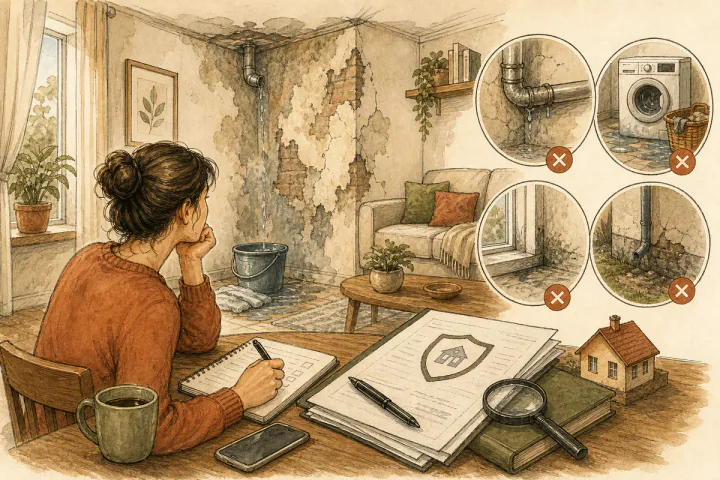
Wear and tear — the policy protects against sudden, unforeseen events. It does not protect against natural ageing of materials, corrosion, mould from long-term damp. If the roof has been leaking for years — that's a wear loss, not an insurance event.
How do you set the right sum insured?
The sum insured is a parameter you choose yourself when buying the policy. The insurer does not verify it at signing. They verify it at the claim. And if the sum is too low — they apply the proportional rule.
There are two approaches to valuing walls:
Reinstatement (new) value — what it would cost to rebuild or repair the property to new condition. This is the right approach. The maths: usable floor area × current cost of construction per m² in your region. Indicative costs (2025–2026, Poland, from developer-finished to fully fitted): PLN 4,000–6,500/m² (Statistics Poland, residential building prices, 2025). A 60 m² flat → reinstatement value: PLN 240,000–390,000.
Actual value (with depreciation) — value adjusted for wear. Lower sum, lower premium — but a lower payout at claim, because the insurer deducts depreciation. Used more often for contents on cheaper policies.
For contents: realistically estimate the value of your furniture, appliances, electronics, clothing and valuables. Most owners understate this by habit. Walk room by room with a calculator. Once, thoroughly — then just update after larger purchases or a renovation.
The right sum insured for a flat's walls should match its reinstatement value, not its purchase price or market value. In Poland, the indicative rebuild cost is PLN 4,000–6,500/m² in 2025–2026 (Statistics Poland, indicative data). Understating that figure automatically triggers the proportional rule and caps every payout — in proportion to how underinsured you are.
Is personal liability the cheapest important add-on to a home policy?
Personal liability covers your financial responsibility for damage caused to third parties outside of work and outside of vehicles. Sounds abstract until you flood the neighbour.
A typical personal-liability scope includes:
- Flooding the neighbour's flat from your installation or by household members' fault
- A burst pipe damaging the unit below
- A dog biting someone on a walk
- A child breaking a window in a tenement building
Cost of a flood-damage claim: PLN 10,000–80,000, depending on the extent and the value of the neighbour's contents. Cost of personal liability as an add-on to a home policy: PLN 30–100 per year, guarantee sum PLN 100,000–500,000. The potential-loss-to-cost-of-protection ratio here is better than for almost any other policy element.
Check too whether the policy automatically covers all household members. Some policies require members to be named — if a student lives in a rented flat and causes damage, the parents' personal liability may not protect them.
A policy expires more quietly than you think — the same rules apply to personal liability: check whether you have it in the policy, and on what sum.

How do you review your home policy each year without digging through the entire general terms?
A home policy doesn't need to change every year. But the sum insured does. Construction costs rise, you renovate, you buy new equipment. The policy stands still if you don't update it.
One review a year, before renewal, is enough. What to check:
Walls sum insured: does it match current rebuild costs? If you've renovated or construction costs have risen — update it.
Contents sum insured: does it reflect last year's purchases? New appliances, electronics, furniture? Add them to the sum.
General-terms exclusions: where in your policy does the line between water damage and flood lie? Do you have surge cover? Do you have personal liability, and on what guarantee sum?
Quote comparison: 15 minutes on Rankomat, Mubi or Beesafe before renewal. Premiums and scopes differ between insurers.
Documentation: keep the policy together with your home's financial documents — at the claim you need it immediately. At Homeward we want the policy not to be just an attachment in an email, but a living element of the home: with the end date, scope of cover, sum insured, and a place to update it after a renovation or a larger purchase. Homeward is in pre-launch — you can join the waitlist for free.
If you renovated during the year — also check the impact on the sum. We cover how to plan a renovation budget and what to document during works in a separate article.
Frequently asked questions about home insurance
Is home insurance mandatory in Poland?
No — property insurance is not legally required in Poland (unlike third-party motor insurance). Banks require it for mortgages, but usually only for walls. Contents insurance and personal liability are optional add-ons — whose absence shows up at the first claim.
What is reinstatement value and how do I calculate it?
Reinstatement value is the cost of repairing or rebuilding property to new condition, without deducting depreciation. For walls: floor area × cost of construction per m² (PLN 4,000–6,500 in 2025–2026, Statistics Poland). For contents: the price of buying a new equivalent of your current appliances and furniture. Exactly that value should be your sum insured — not what you paid for the flat.
What should I do at the moment of a claim to avoid losing money?
Report the claim as soon as possible — policies usually require notification within 3–7 days. Photograph the damage before cleaning up. Don't throw away damaged items before the loss adjuster's visit. Take witness details for damage caused by a neighbour. Keep your policy number and general terms (OWU) at hand — details on how to keep on top of policy dates are in a separate article (Financial Ombudsman, 2024).
Do I need to inform my insurer after a renovation?
Yes — the sum insured does not change automatically after a renovation. A bathroom refit at PLN 25,000, new furniture or expensive appliances should be reflected in a higher contents sum. Notify the insurer at renewal or within a year of finishing the work. Without that update, you risk being underinsured at the next claim involving the new items. How to collect renovation invoices for tax and insurance purposes — in a separate article.
How does walls insurance differ from contents insurance?
Walls insurance covers permanent elements of the property: walls, installations, joinery, ceilings. Contents insurance covers movable property: furniture, appliances, electronics, clothing. You can have one without the other. With a rental flat: the tenant often insures only contents, the owner — only walls. With an owner-occupied flat: both scopes together give full protection.
Checklist: what to review in your home policy once a year
- [ ] Walls sum insured — does it match reinstatement value (not the purchase price)?
- [ ] Contents sum insured — does it reflect last year's purchases?
- [ ] Water cover — does the policy cover both water damage and flood, or only water damage?
- [ ] Personal liability — is it in the policy? On what guarantee sum?
- [ ] Electrical surge — are electronics covered and up to what amount?
- [ ] Expiry date — when, how many weeks to renewal?
- [ ] Quote comparison — 15 minutes on a price comparison site before renewal
- [ ] Update after renovation — if you renovated, update the sum
- [ ] Offline copy of the policy — PDF on your phone or print, not just in the insurer's email