Key takeaways
- The chimney inspection is a legal duty under Article 62 of the Construction Law — a fine of up to PLN 500 for neglect (GUNB, 2025).
- The State Fire Service records hundreds of fires and CO poisonings each year directly linked to blocked chimneys and faulty heating (PSP, 2025).
- A complete winter prep costs from ~PLN 430 (budget bundle) to PLN 1,500+ (comprehensive bundle).
- The best date for the checks is September, before chimney sweep and boiler service calendars fill up for weeks.
Winter prep for a home isn't tradition or good practice. It's largely a duty under the Construction Law — and concrete protection against costs that can surprise you at the worst moment. Statistics Poland reports that heating accounts for over 62% of energy used by Polish households (Statistics Poland, 2026). This guide gathers everything in one place: legal duties, concrete costs and the order of actions.
What legal duties does a homeowner have before winter?
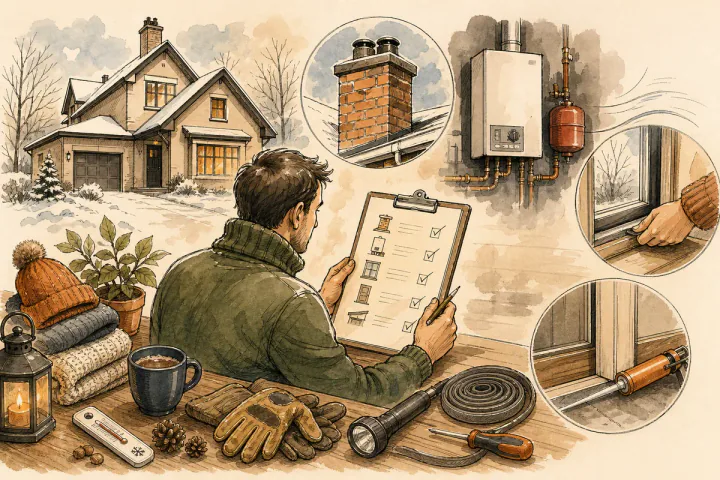
Article 62(1)(1) of the Construction Law obliges the owner or manager to perform at least once a year a check on the building's technical condition, including gas installations and chimney ducts (GUNB, 2025). Failure to perform this duty risks administrative proceedings and an order to carry out works.
Many homeowners treat the chimney inspection as a formality. In reality it's one of the few building duties that directly protects the household's health. A blocked chimney isn't an aesthetic problem — it's potential CO poisoning.
What Article 62 says
The rule applies to all buildings, including single-family homes. The check covers the technical condition of chimney ducts (smoke, flue and ventilation), gas installations and the condition of elements exposed to weather. The document after the check is the report, which the owner is required to keep.
Single-family owner vs. housing community
A single-family home owner is solely responsible for all the checks. In a housing community the split is different: the community is responsible for the common parts (the main chimney, common installations), and the unit owner for installations inside the flat and equipment installed at their own cost. Check the community's rules — scopes vary.
PSP requirements on smoke and CO detectors
The State Fire Service recommends installing a CO detector in every room with a fuel-burning unit or connected to such a room (PSP, 2025). A smoke detector should be in every sleeping zone. Replacing batteries or expired detectors is a task to do before the season, not during it.
Complete winter home prep checklist with costs
The State Fire Service notes that most heating-season CO incidents share one factor: a neglected chimney or boiler inspection (PSP, 2025). The table below organises every key task with indicative costs and the legal basis.
| Task | When | Indicative cost | Legal basis / note |
|---|---|---|---|
| Chimney inspection | Yearly, September–October | PLN 150–300 | Art. 62 Construction Law, yearly duty |
| Boiler/stove check | Yearly before season | PLN 200–400 | Manufacturer warranty condition |
| Roof inspection | Yearly before winter | PLN 200–500 (check) | Art. 62 Construction Law, facade and roof condition |
| Window and door sealing | Every 3–5 years or as needed | PLN 50–200 (materials) | Good practice, affects energy class |
| External pipe insulation | Before first frost | PLN 30–100 | Protection against pipe burst |
| Electrical installation check | Every 5 years (duty) | PLN 300–600 | Art. 62 Construction Law, full check |
| Smoke and CO detectors | Yearly (test) / every 5–10 years (replace) | PLN 50–150 (new detector) | PSP recommendation, EN 14604 and EN 50291 |
| Garden and terrace prep | October–November | PLN 0–200 (materials) | Good practice, protects surfaces and plants |
| Gutter and drain cleaning | September–October | PLN 0–150 (DIY or service) | Good practice, protects foundations |
In practice the biggest challenge isn't doing the checks, it's getting a slot. Chimney sweeps and boiler technicians get booked up from mid-September. Anyone waiting until November often hears "earliest in three weeks".
Chimney inspection — what the sweep checks
During the inspection the sweep evaluates duct flow (smoke, flue, ventilation), the condition of internal chimney walls, joint tightness and draught. The report after the inspection is a document — keep it with the invoice and other property documents. If the sweep finds irregularities, they're obliged to inform the owner in writing.
Boiler check — when it makes a difference for the warranty
Most condensing boiler manufacturers require an annual check by an authorised service as a warranty condition. Missing service documentation can result in refused warranty cover, even when the fault is unrelated to the missed check. Details on boiler checks and warranty impact are in the separate article on boiler inspection.
Roof, gutters and drains — why urgent before December
Snow and ice on a damaged roof do more damage than a year of rain. Leaves in gutters block the run-off of meltwater, which finds its way through the facade or foundations. A roof check before winter doesn't have to be expensive — a walk-round with binoculars and a check on flashing, gutters and tiles after the summer storm season is enough.
Article 62 of the Construction Law requires checks of electrical and lightning installations every 5 years. If you can't remember the last one — it's probably long overdue. The check report is required for insurance by some insurers.

How much does complete winter home prep cost?
Statistics Poland reports that property maintenance and repair spending makes up on average 5–8% of annual household spending (Statistics Poland, 2026). Winter prep is just part of that, but it's possible to plan ahead.
| Bundle | What's included | Estimated cost |
|---|---|---|
| Budget | Chimney inspection + detector test + DIY sealing | PLN 150–430 |
| Standard | Budget + boiler service + gutter cleaning | PLN 450–850 |
| Comprehensive | Standard + roof check + pipe insulation + window sealing | PLN 800–1,500+ |
The budget bundle is the absolute minimum. It includes the only two actions you can't skip: the chimney inspection (legal duty) and a detector check (life safety). The rest can be spread over years if budget is tight.
Worth seeing winter check costs as insurance, not expense. A boiler failure in the middle of winter costs PLN 2,000–6,000 to repair or replace. A burst pipe after frost is often PLN 3,000–8,000 in repairs. PLN 400–600 a year on checks is different maths.
| Action | Preventive cost | Failure cost |
|---|---|---|
| Boiler service | PLN 200–400/year | boiler replacement: PLN 3,000–8,000 |
| Pipe sealing | PLN 50–100 | repair after burst: PLN 3,000–8,000 |
| Chimney inspection | PLN 150–300/year | repair after fire: PLN 10,000+ |
Market estimates, Homeward data 2025
How to limit heat losses without a renovation?
Room heating in 2024 accounted for over 62% of energy used by Polish households (Statistics Poland, 2026). Small leaks and bad radiator settings can mean a 10–15% higher bill across winter for no other reason.
Windows and doors — sealing you can do yourself
Window seals and door strips cost PLN 20–80 a set per window or door. Replacement takes 15–30 minutes. Simple test: light a candle or incense by the window edges on a windy day. If the flame flickers, the seal needs replacing or filling. It's the cheapest gain on the whole winter list.
Radiators and thermostats — settings that lower bills
Furniture placed directly in front of a radiator can lower heating efficiency by 10–20%. Curtains covering the radiator do similar damage. A head thermostat set to 20°C instead of 22°C can mean 6–8% savings on energy use through the season. No spending — just adjustment.
Air vents — don't tape them up
Sealing air vents with foil or tape is a common mistake that can lead to ventilation problems and — with fuel-burning units — a CO poisoning risk. The vent has to let air in even with airtight windows. If draughts bother you, the problem is the lack of a second ventilation source, not the vents.
If the winter check reveals bigger insulation problems, see what thermal-modernisation funding covers: home insulation and the thermal-modernisation programme.
How to prep the garden and terrace for winter?
Garden and terrace are the area homeowners most often push off "to next week" — and suddenly it's November and the garden furniture is under snow. Good prep takes one afternoon and protects against damage that costs many times more.
Pre-winter garden tasks don't need specialists. You can do them yourself in one or two free days.
What to do with garden furniture and equipment
Plastic and aluminium garden furniture take winter under a cover or roof. Wooden furniture shouldn't be left outside without protection — wet wood cracks in frost. Grill, hoses and watering equipment need draining and storage above freezing. Water frozen in a hose or pump destroys them irreversibly.
Insulating external pipes and water points
External pipes and garden taps are the most frequent first-frost casualties. Pipe foam costs PLN 5–15 per metre. A garden tap cover costs PLN 10–20. Minimal investment. The alternative is shutting off the valve to outdoor water points and blowing out the line.
Plants and surfaces
Frost-sensitive perennials need agrofleece covers or mulching. Wooden terraces and composite boards are worth treating with preservative before the season — water absorbed into wood and freezing destroys the structure. Paving doesn't need protection, but check joint condition — washed-out joints are loose plates under snow.
How to organise documents after the check?
GUNB describes the report as a required check document the owner is obliged to keep (GUNB, 2025). In practice, reports from several years kept together with invoices and recommendations form a technical history of the home that has concrete value.
Documentation is useful in four situations. At a claim, when the insurer may ask about the last chimney or boiler check. At a warranty complaint, where missing service documentation often means refusal. At property sale, where buyers and notaries ask about the inspection history. And at the next service, when the technician wants to know what was done a year ago.
Exactly for this need — a history of checks, services and renovations that has value at sale — Homeward is building the Home Passport. Not another cloud folder, but a technical home history tied to specific units and rooms. Homeward is in pre-launch — you can join the waitlist for free.
What to keep after each check
Minimum: date of execution, company or specialist details, cost, report or invoice with description of work, recommendations and the next check date. Photos of faults with dates are extra protection — especially useful when a fault recurs and there's a dispute over responsibility.
How to spread winter prep over time?
The biggest peace of mind in practice comes not from the list itself, but from repeatability. If every year you do the same check in the same month, the home gains a rhythm. Backlogs don't pile up and costs become predictable.
Prep can be split into three stages.
September — checks ahead of time. Chimney, boiler, detectors. These tasks need specialists and the slots fill up. Booking in October often means waiting until November.
October — comfort and tightness. Windows, doors, air vents, radiators. Garden and terrace. Gutters after the leaves. These jobs you can do yourself or with a handyman's help.
November — documents and plan. Gather all reports, invoices and recommendations. Note dates for next year. Review the "to repair" list and quote works worth ordering in spring.
This rhythm eliminates the December scenario where the chimney sweep can't come before Christmas and the boiler refuses to cooperate.
FAQ
The Construction Law, PSP requirements and the maths of winter checks raise the same questions every year. Answers gathered below.
When should I do the winter home check?
The best date is September or early October. Chimney sweeps and boiler technicians still have free slots, and the homeowner has time to fix any faults before the heating season. Waiting until November risks not getting a slot before winter.
Is the chimney inspection mandatory in a single-family home?
Yes. Article 62 of the Construction Law doesn't limit the duty to multi-family buildings. The owner or manager of every building is obliged to carry out a yearly technical condition check, including chimney ducts (GUNB, 2025). A missing report can complicate a claim with the insurer or a property sale.
Does a CO detector replace a chimney inspection?
No. The detector is an alarm, not prevention. It can warn of a threat when one occurs. It doesn't replace working ventilation, a serviced boiler or duct checks. PSP recommends treating detectors as an extra safety layer, not a substitute for inspections (PSP, 2025).
How much does complete winter home prep cost?
It depends on the scope. The minimum bundle (chimney inspection and detector test) is about PLN 150–430. The standard bundle with boiler service and gutters is PLN 450–850. The comprehensive bundle with roof check, sealing and pipe insulation is PLN 800–1,500. Costs can be spread over years, starting with the mandatory checks.
What should I document after the winter check?
Date, contractor details, cost, report or invoice with description of work, recommendations and next check date. Photos of faults with dates are extra protection. Such documentation helps with insurance, warranty complaints, property sale and the next service a year later.
Does a flat in a block need the same checks?
The scope is different. In a housing community the main chimney, common installations and roof belong to the community, which orders and pays for checks. The unit owner is responsible for installations inside the flat and for equipment installed at their own cost, e.g. an AC unit or fireplace. Worth checking the community's rules and the reports from common-parts inspections.
A winter home check isn't a list of things to do "when there's time". It's a set of duties and decisions that protect safety, budget and property value. A chimney once a year is a legal duty and PLN 150–300. A boiler once a year is a warranty condition and PLN 200–400. The rest is a decision about how much winter peace of mind is worth.
The most important thing? Book the slots in September, before specialists are unavailable for weeks.
The detailed boiler inspection guide and information on thermal-modernisation funding are in separate articles.