Key takeaways
- In Poland every new appliance is covered by the statutory guarantee (rękojmia) for 2 years — regardless of the manufacturer's warranty. Without proof of purchase, however, it's hard to use (Consumer Rights Act, 2014 as amended).
- A washing machine or dishwasher repair without warranty costs PLN 250–600. At an appliance price of PLN 1,500–3,000 that's 15–30% of its value — for a lost piece of paper.
- An average Polish household has 8–12 appliances under active warranty or rękojmia, at different end dates.
- One folder with photos of receipts and warranty cards is enough to have access to everything in 30 seconds.
Every home knows that drawer
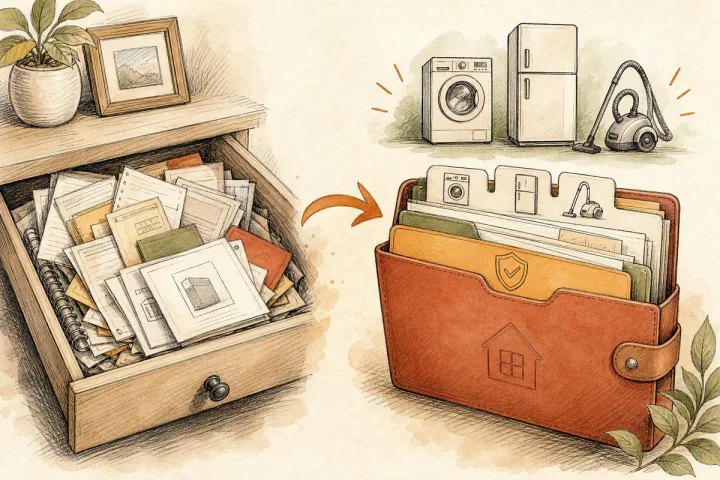
There's that drawer. Or that box on the top shelf. Maybe a binder where you throw "important papers". Somewhere in there sits the washing machine warranty, the oven receipt, the boiler service card. You know you put them there. You just don't remember when — and whether for sure.
The washing machine breaks down. You hear a strange noise, the cycle stops. A two-year-old machine. You definitely have warranty. You start looking. Receipt? Maybe in emails, maybe printed. Warranty card? In the washing machine box, which you threw out a year ago.
You lose 40 minutes searching, finally give up and call the service. "How much is a diagnostic?" — you ask. And that's where it really hurts.
Working on Homeward, we gathered homeowners' stories about everyday frustrations with managing a property. The "drawer of warranties" theme came up more often than anything else. It's not laziness. It's that most people don't have a system where proof of purchase, serial number, warranty terms and a service note live next to each other.
Rękojmia and warranty — two different things, both important
This distinction matters more than it seems. Many Poles treat "warranty" and "rękojmia" as synonyms — they're two completely different tools, with different rules and different parties responsible.
Rękojmia is a statutory obligation under Polish law (the Consumer Rights Act) and the EU directive. It applies for 2 years from the purchase of every new good, no exceptions. The seller cannot exclude or limit it in a consumer contract. In the first year from purchase: if something breaks, the defect is presumed to have existed at purchase — the seller must prove there was no defect. In the second year: you have to show the defect was hidden at the moment of purchase (UOKiK, 2025).
The manufacturer's warranty is a voluntary promise — made by the manufacturer, independent of rękojmia. The manufacturer sets terms: period (usually 2–5 years), scope (what's covered, what isn't), reporting procedure. The warranty can be broader or narrower than rękojmia, depending on the manufacturer and product.
The practical difference: with rękojmia you go to the seller. With the warranty — to an authorised manufacturer's service. You can choose which path to use.
Where's the trap? In both cases you have to prove when and where you bought the appliance. Without a receipt or invoice that's hard. And that's where the real problem starts.
How much does a repair without documents cost?
When you can't use rękojmia or warranty — you pay from your own pocket. The service quotes a cost, you decide whether to repair. With large appliances, that decision is painful.
According to Polish appliance repair services, in 2024–2025 typical repair costs look like this (indicative service rates, 2025):
These are not small amounts. On a PLN 1,800 washing machine the repair is 30–35% of the appliance's value. For a receipt that got mislaid somewhere.
In practice this is one of those expenses that stay invisible for a long time, then suddenly hit at full cost. The mechanism is similar to other silent home costs: the problem grows quietly until you have to pay.
And one important thing: you don't have to have the physical warranty card. For rękojmia, proof of purchase is enough — a receipt, invoice, bank transfer confirmation, card statement. Anything that confirms the date and place of purchase. For the manufacturer's warranty — check the terms; sometimes the serial number and purchase date in the manufacturer's system are enough.
In Poland rękojmia is in force for 2 years from purchase of every new consumer good, regardless of the manufacturer's warranty. To use it, you simply need to prove the date and place of purchase — a receipt, invoice or transfer confirmation will do. A physical warranty card is not legally required to file a rękojmia complaint (UOKiK, 2025).
What exactly is worth having for every appliance?
It's not about a complete documentation set — it's about the minimum that lets you act quickly when something breaks.
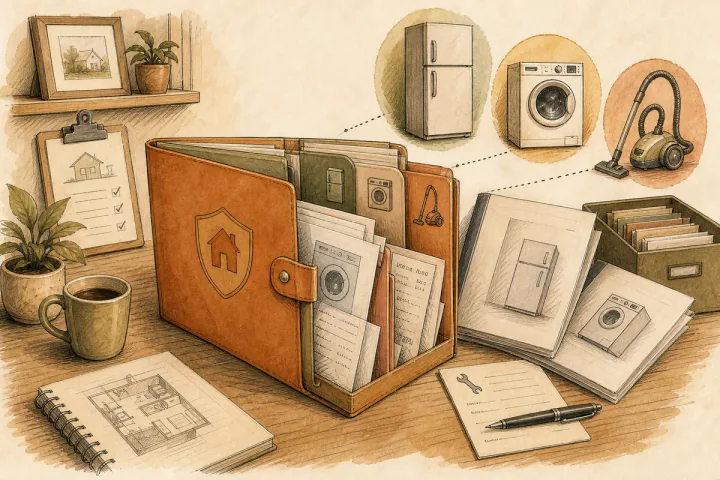
For every appliance and electronics device, keep:
- Proof of purchase (receipt, PDF invoice or photo)
- Date of purchase and place (shop, website)
- Model and serial number (usually on a sticker on the back or underside)
- Manufacturer's warranty terms — how many years, what's covered, which service
Also worth knowing:
- Whether the manufacturer offers product registration (online registration often extends the warranty)
- Which service is authorised for the brand in your city
- Whether you have an extended store warranty (often sold at purchase)
The serial number is the key. Appliance manufacturers (Bosch, Miele, Samsung, LG, Indesit) have systems where entering the serial number lets you check the manufacturing date, service history and warranty terms. Without the serial number — much harder.
Worth knowing that "parts warranty" and "service labour warranty" are often two different periods on a warranty card. A manufacturer may warrant parts for 5 years, but labour for only 2. That difference is sometimes hidden in the fine print and shows up exactly when someone tries to report a fault in year 3.
Typical manufacturer warranty periods in Poland:
| Appliance category | Standard manufacturer warranty |
|---|---|
| Large appliances (washing machines, fridges, dishwashers) | 2 years (some 5 years on the motor) |
| Small appliances (coffee machine, kettle, toaster) | 2 years |
| Electronics (TV, speakers, projectors) | 2 years |
| Laptops and tablets | 2 years (often 1 year in practice) |
| Heating boiler | 2–5 years (depends on manufacturer) |
| Heat pump | 2–5 years |
Statutory rękojmia: 2 years for all categories, regardless of manufacturer's warranty.
Warranty periods per manufacturer's declarations — may vary. Check the documentation of the specific product.
For heating equipment (boiler, heat pump) the warranty is usually conditional — it requires an annual service by an authorised point. Details in the article on home technical inspections.
How do you organise warranties at home?
The system doesn't need to be complicated. It only needs to exist — and be in one place.
Option 1: Folder of PDFs on disk or in the cloud.
One folder "Home appliances". Subfolders by category or appliance name. In each: receipt photo, PDF invoice or warranty card, photo of the rating plate with serial number. This works and costs PLN 0.
Option 2: Home management app.
We're building Homeward for exactly this — so the document isn't just a file in a folder. Notion, Airtable or Apple Notes store the file — but don't know that the washing machine warranty expires in a year, that the service needed specific parts, or that the next technician will need the report from the previous repair. Homeward links proof of purchase, serial number, end-of-cover date, service contact and repair history in one place, with reminders before you lose protection. Homeward is in pre-launch — you can join the waitlist for free.
Option 3: Physical binder (if you prefer paper).
Tabs by appliance category, each with a copy of the receipt and warranty card. Keep it somewhere accessible, not "in that drawer".
The key: one place. Not "either here, or there". One rule: every new purchase → 5 minutes to add the document to the system. While the appliance is still working and you have everything to hand. The same rule applies to all home financial documents — bills, renovation invoices, tax documents.
Frequently asked questions about appliance warranties
Can I file a complaint without a receipt?
A receipt is the most convenient, but not the only proof of purchase. You can use an invoice, transfer confirmation, card statement printout or bank account history. What matters is that it shows the date and place of purchase. The seller cannot refuse to handle a complaint solely because a receipt is missing (UOKiK, 2025).
What's the difference between statutory guarantee (rękojmia) and warranty?
Rękojmia is the consumer's statutory right — 2 years from purchase, always in force, complaints go to the seller. A warranty is a voluntary manufacturer's promise — terms, length and scope are set by the manufacturer, complaints go to the authorised service. You can choose which basis to use at a fault.
How long does rękojmia last and when can I use it?
Rękojmia on new consumer goods lasts 2 years. In the first year the defect is presumed to have existed at purchase — the seller has to prove otherwise. In the second year you have to show the defect was hidden at the moment of purchase. After 2 years rękojmia expires, but the manufacturer's warranty may still apply.
Is it worth registering a product on the manufacturer's site?
Yes, often. Many appliance manufacturers (Bosch, Siemens, Miele, Samsung, LG) extend the warranty by 1–3 years in exchange for registering the product on their portal. Beyond that, registration records the purchase date and serial number in the manufacturer's system — which can help with a complaint even if you lose the receipt.
How long should I keep warranty documents?
At least for the full warranty and rękojmia period — i.e. a minimum of 2 years from purchase. For equipment with extended warranty — for the whole period plus one year after expiry (in case of disputes). For expensive units (boiler, heat pump) keep documents for the whole operating life — they're useful for service and when selling the property.
Checklist: documents worth having for every appliance
- [ ] Receipt or invoice (PDF or photo)
- [ ] Date of purchase and shop name
- [ ] Model and serial number (photo of the rating plate)
- [ ] Warranty card or manufacturer's warranty terms
- [ ] Was the appliance registered with the manufacturer?
- [ ] Contact for the authorised service nearby
- [ ] Note after each repair (date, fault, cost, service)