Electricity bills in Poland have grown faster than most other home costs over the last three years. According to URE data, the electricity price for households rose by over 60% between 2022 and 2024 (URE, 2024). The good news is that most Polish homes have literally hundreds of zlotys of savings to capture without any renovation. Below are five concrete ways with numbers.
Key takeaways
- Heating is around 55% of home energy use, but that's not where the fastest savings sit for a typical resident (Statistics Poland, 2026).
- Electronics on standby take 5–10% of energy in a Polish home, which at average usage is PLN 200–400 a year of waste (IEA, 2023).
- Switching from the G11 to G12 tariff can save PLN 300–600/year, but only when you move large usage to cheaper hours.
- All five methods combined deliver PLN 850–1,750/year of potential savings in a typical Polish home.
Why look at kWh first, not the bill amount?
In 2024 households were responsible for over 20% of national energy use, with room heating taking just over 62% of energy consumed at home (Statistics Poland, 2026). Before you change anything, you need to know whether your problem is usage or price.
A bill can rise for four different reasons: higher energy price, higher distribution charges, a longer billing period or genuinely higher usage. Fixing habits won't help if the problem is in the tariff. And vice versa.
The Energy Regulatory Office (URE) recommends reading the bill through the prism of kWh and the breakdown of charges, not just the amount due (URE, 2026). Gather the last 12 months of invoices. Put kWh in a table. Only then look for the cause of the increase.
Way 1: Eliminate standby power draw
Electronics on standby account for 5–10% of energy use in a typical European home. At Polish average usage ~2,200 kWh/year and a price ~PLN 0.90/kWh (G11 tariff in 2024, URE, 2024) that's 100–200 kWh per year, i.e. PLN 200–400/year of waste for no benefit (IEA, 2023).
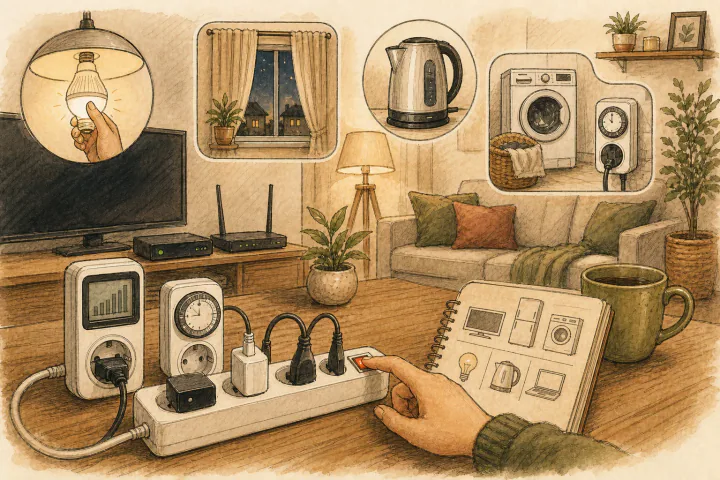
In practice the worst offenders are TV with a set-top box, games console, old printer, and chargers plugged in permanently. Together they can draw 30–50 W around the clock, even when "doing nothing". A power meter for PLN 30–50 is a one-off investment that shows which device is actually worth turning off.
The solution is banal: one switched power strip at the AV stack and a habit of taking chargers out of the wall. It's boring. That's exactly why it works.
There's more on these hidden losses in the silent home costs article.
Estimated savings: PLN 200–400/year
Way 2: Improve cooking and kitchen efficiency
The kitchen accounts for ~15% of home electricity use, excluding heating (Statistics Poland, 2026). At typical usage that's ~330 kWh per year. Part of it can be cut by habit changes alone, without replacing equipment.
Four changes with the biggest effect: a pot sized to the burner (a smaller pot on a big burner loses 30–40% of heat to the sides), a lid while cooking (cuts time by a dozen percent), a fridge at 5–6°C instead of 2–3°C, and a dishwasher only with a full load.
In our view kitchen energy saving most often fails when it starts with sacrifices. It's better to focus on losses that don't give any comfort, such as a pot beaming heat into the air. Comfort stays, the bill falls.
Estimated savings: PLN 150–300/year
Heating dominates the structure, but standby and the kitchen give the fastest return on action.
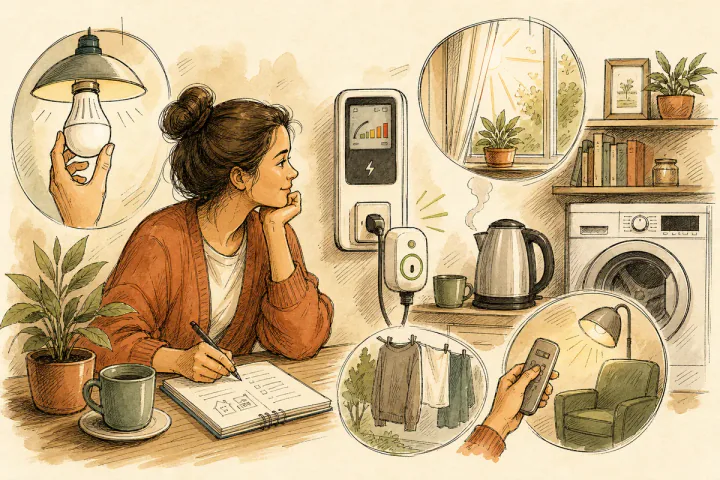
Way 3: Switch bulbs and fittings to LED
Replacing every traditional and halogen bulb with LED is one of the few home investments that pays back in under a year. An LED bulb draws 5–10 W instead of 40–60 W for the same brightness, i.e. 80–90% energy savings on lighting (European Environment Agency, energy efficiency, 2023).
In a typical home with 20 light points and 4 hours of daily use, the switch gives ~150–250 kWh/year less. At PLN 0.90/kWh that's PLN 135–225/year. Cost of a full set of LED bulbs: PLN 150–300. Payback: 12–18 months.
An extra effect is less heat given off by fittings in summer. A traditional bulb converts ~90% of its energy into heat and only 10% into light. In rooms with AC this creates double losses: you pay for the bulb's electricity and for the AC's electricity to remove that heat.
Estimated savings: PLN 100–225/year, payback in 12–18 months
Way 4: Plan usage smartly with timer sockets
Auto-shutting devices at night or while you're out is a step below smart home and several steps above just remembering to turn things off. Timer sockets (price: PLN 30–80) let you schedule an electric water heater, bathroom heater or device charging into cheaper hours.
On the G12 tariff, night electricity is about 30–40% cheaper than peak. Even without a tariff change, switching off standby and supplementary heating for 8 hours a day produces measurable effects. About PLN 100–250/year with consistent use at two or three points.
If you have an 80–120-litre electric water heater that runs at night for the whole day's hot water, that's one of the biggest single sources of savings available without a renovation.
Estimated savings: PLN 100–250/year
Way 5: Switch to the dual-zone G12 tariff
The G12 tariff splits the day into two zones: cheaper night (usually 22:00–6:00 and weekends in some variants) and more expensive day. URE explains that multi-zone tariffs make sense only when you actually move usage to cheaper hours (URE, 2024). Without changing habits, the tariff switch can increase the bill.
Who benefits most? Households with a heat pump, electric water heater, tumble dryer, dishwasher or EV charger. These are easy to run overnight or set on a timer. At yearly use of 4,000–5,000 kWh and shifting 40–50% of usage to the cheap zone, savings are PLN 300–600/year.
The tariff change is free. The application goes to your energy seller, and from the new billing period the new tariff applies. The technical condition is a meter that supports zoning — standard in most newer installations.
Estimated savings: PLN 300–600/year
Quick wins: summary of the five ways
| Change | Cost to implement | Yearly savings | Payback |
|---|---|---|---|
| Eliminate standby (switched strips) | PLN 50–100 | PLN 200–400 | 2–4 months |
| Kitchen habit changes | PLN 0 | PLN 150–300 | immediate |
| LED bulb replacement | PLN 150–300 | PLN 100–225 | 12–18 months |
| Timer sockets (2–3 pcs) | PLN 60–240 | PLN 100–250 | 4–12 months |
| G11 → G12 tariff switch | PLN 0 | PLN 300–600 | immediate |
| Total | PLN 260–640 | PLN 850–1,775 | 4–9 months |
The savings stack. A home that implements all five changes has a realistic chance of cutting the bill by PLN 70–150/month. No renovation, no big investment needed. Just a few decisions and a little organisation.
Worth tracking bills together with the household budget too. The article on household spending planning shows how to combine utility bills with the rest of home maintenance costs.
FAQ
Where do you start cutting the electricity bill?
Start by comparing kWh from the last 12 months, not the amount due. The amount can rise because of energy price or distribution charges, not your usage. Only when you see the kWh trend can you identify the right problem and pick a method from the list above.
Does switching from G11 to G12 always cut the bill?
Not always. The G12 tariff only makes sense if you actually move large usage to cheaper hours — laundry, dishwasher, water heater, or EV charging. Without changing those habits you may pay more, because the peak G12 price is higher than the flat G11 rate.
How much does a power meter cost and is it worth buying?
A socket power meter costs PLN 30–60 and is a one-off investment with immediate payback. It lets you measure the real draw of each device and find — within a quarter of an hour — equipment that consumes power disproportionately to its usefulness. Old appliances can draw 2–3 times more energy than the manufacturer states after a few years of operation.
How fast does switching bulbs to LED pay back?
At typical LED prices (PLN 10–20 each) and savings of PLN 4–8/year per bulb, payback is 15–30 months per lamp. When you replace the whole home at once, costs are lower and savings cumulate. So replace at the point of failure rather than wait for whole-system breakdown.
Is it worth keeping electricity bill history?
Yes — and it's the condition for the other four methods to work. Without kWh history over time you don't know whether the tariff change helped, whether a new device increased usage, or when something started drawing more than it should. A simple table is enough: date, kWh, amount, major change in the home. After a year you have the full picture. Homeward collects this history together with other home documents — electricity bills, service invoices and renovation costs in one place, so a change in the chart has context, not just a number.
Summary
The five methods in this article don't require a renovation, a grant or specialist knowledge. Combined they deliver PLN 850–1,775 of yearly savings potential in a typical Polish home, with own outlay from PLN 0 to about PLN 640. The fastest payback comes from the tariff change and eliminating standby, because they cost almost nothing.
The key is order: first measure (kWh from bill history), then eliminate losses with no sacrifice (standby, kitchen habits), then invest where the payback is short (LED, timers), and finally match the tariff to your usage profile.
If you want bills, contracts and a history of changes in one place, so the electricity invoice is part of a broader picture of home costs, you can join the Homeward waitlist for free.
More on combining utility bills with the home spending plan: calm budget and home cost planning.