Key takeaways
- Devices in standby account for 5–10% of yearly electricity use in an average home — at Polish rates that's PLN 110–250 a year for energy you don't actually use (IEA, World Energy Outlook 2024).
- A dripping tap wastes up to 14,000 litres of water a year. At Polish water rates (PLN 8–18/m³) that's PLN 110–250 for water that drains away unused (Statistics Poland, water and sewage infrastructure 2024).
- A small fault fixed immediately costs tens of zlotys. The same fault ignored for a year grows to hundreds or thousands — because water soaks the wall, mould grows, plaster falls off.
- Switching from G11 to G12 tariff can cut your electricity bill by 15–25% — but only with the right usage profile (URE, electricity prices report 2024).
How does a home spend money without you noticing?
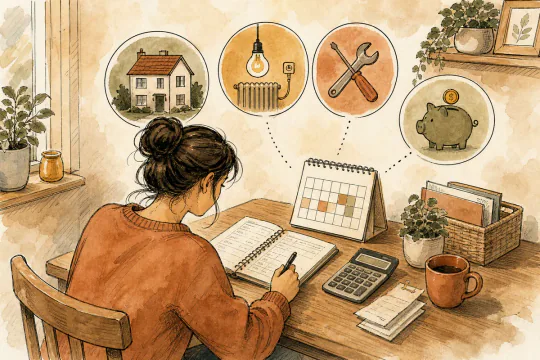
There are costs that don't appear on any one invoice. No letter arrives, no deadline passes. You simply pay a bit more every month than you should — and you don't know where it goes.
A fridge working 20% harder because its seal is worn. A bathroom tap that's been dripping at night for a year. A TV that's never really off. An electricity tariff from five years ago, picked for different usage hours. A gutter you meant to fix in May, and now it's November.
Each of these feels trivial. Together they can cost PLN 800–2,000 a year — quietly, with no drama, with no one big bill to grab your attention.
In practice few people want to deal with these things day to day. It's hard to remember the purchase date of an appliance, the service deadline, the boiler check, the tariff change, or that small fault that "can still wait". This is exactly where Homeward can help: gather the home's history and its appliances, remind you about checks and service visits, keep an eye on important dates, and surface the small slips that, after a few months, start costing real money.

How much does standby cost every night?
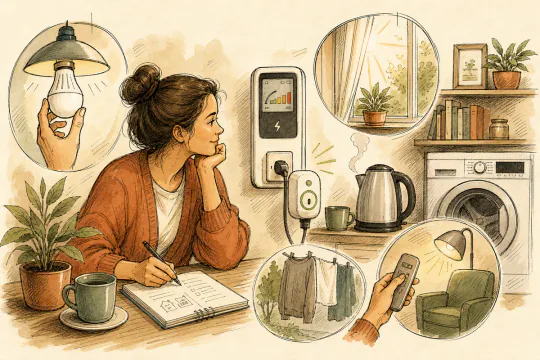
According to the International Energy Agency, devices on standby account for 5–10% of energy use in an average home (IEA, World Energy Outlook 2024). For a Polish home using 3,000 kWh a year that's 150–300 kWh — PLN 125–255 at 2025 rates. For energy no one consciously uses.
The scale is not obvious because standby is usually only a few watts per device — invisible day to day, meaningful over the year.
The priciest devices on standby (typical home estimates):
| Device | Typical standby draw | Yearly cost (~PLN 0.85/kWh) |
|---|---|---|
| TV set-top box / router | 5–12 W | PLN 37–89 |
| Television | 0.5–2 W | PLN 4–15 |
| Games console | 1–10 W | PLN 7–74 |
| Chargers (phone, laptop) | 0.1–2 W | PLN 1–15 |
| Microwave | 1–3 W | PLN 7–22 |
| Total | 15–40 W | PLN 110–240 |
Source: estimates based on IEA and European Commission data, URE energy prices 2025
What to do? A power strip with a switch — one for the AV gear, one for the desk. One button turns it all off. Cost of the strip: PLN 30–60. Payback: under half a year.
Standby is unusually hard to eliminate by habit — because turning the TV off with a remote isn't a real off. A switched power strip changes that structurally: one gesture replaces several decisions. Devices with no real power draw consume nothing — unlike devices on "standby", which often wait for a network signal or an internal clock.
How much do leaky taps and cisterns really cost?
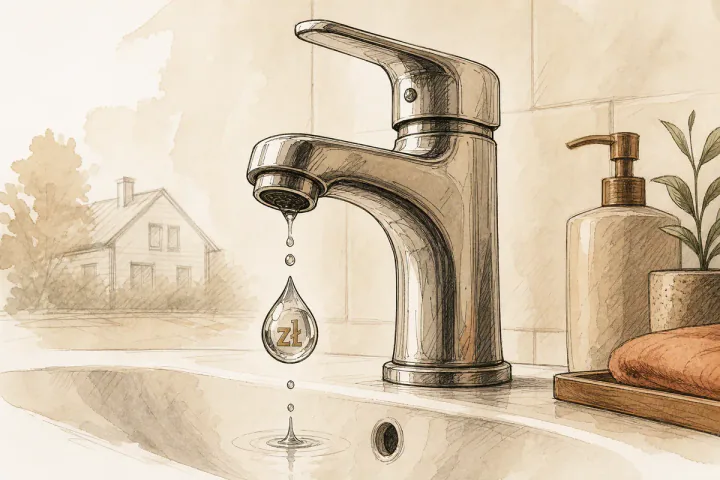
A tap dripping at one drop per second loses about 14,000–15,000 litres a year (plumbing estimate: 1 drop/sec ≈ 15 ml × 86,400 s = 1.3 m³/month). At Polish water and sewage rates combined (PLN 8–18/m³ depending on the municipality) that's PLN 112–270 for 14 m³ of water that never reached a glass or a sink.
One dripping tap in Poland is "only" a few hundred zlotys a year. But a typical flat has 2–3 taps and 1–2 cisterns. A cistern seal costs PLN 5–15 and takes 20 minutes to replace. A leaking cistern wastes 200–400 litres a day — twice as much as a tap.
Most owners don't hear a leaking cistern — unlike a tap, the sound is quiet and only comes when the toilet is used, not between visits. A simple test: a few drops of food colouring in the tank. If the colour appears in the bowl without flushing — the cistern leaks.
When do old appliances and bulbs start costing too much?
The new EU energy classes for appliances, in force since 2021, are stricter than the old ones — what used to be class A+ is now often class E or F (European Commission, Regulation (EU) 2017/1369, 2021). The differences between classes feed straight into your electricity bill.
Example: a 2008 fridge typically uses 380–450 kWh a year. A new class-A fridge of the same capacity uses 100–150 kWh. The 300 kWh gap is PLN 255 a year. Over the new appliance's 15-year lifespan that's PLN 3,825 saved on electricity alone — before you count the repairs on the older unit.
LED lighting vs. traditional light sources:
Swapping 10 traditional 60 W bulbs for LEDs saves ~PLN 645 a year on lighting alone. Replacing every fitting costs PLN 100–200 and pays back in 2–4 months.
Does your electricity tariff still make sense?
Most Polish households are on the G11 tariff — a single rate round the clock. The G12 tariff splits the day into zones: the night zone (22:00–6:00) is 40–60% cheaper than the day zone. G12w introduces three zones.
Who should consider switching to G12? Anyone who:
- charges an EV at night,
- has a heat pump,
- runs the washing machine or dishwasher after 22:00,
- has a hot-water tank with storage.
For a home with a heat pump and an EV charger, switching to G12 can cut the bill by 15–25% at the same usage (URE, electricity prices report 2024). That's PLN 300–700 a year — for one change on the energy seller's website.
If you mostly use electricity during the day and don't have those appliances — G12 may turn out more expensive than G11. What counts isn't which tariff "sounds better" but which profile matches your actual use. Most energy sellers offer a tariff calculator — pull your monthly usage history and compare.
When does a delayed repair start costing more?
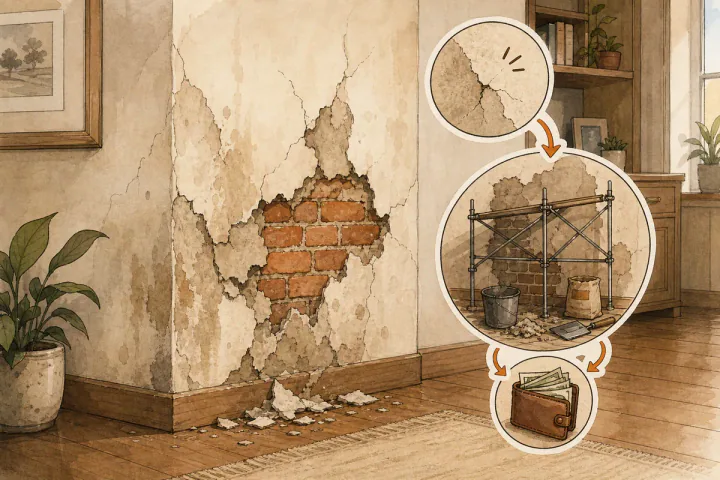
Replacing a roof tile costs PLN 200–500. A leaking roof over 2–3 winters destroys insulation, soaks the wall and starts mould. The repair after that scenario: PLN 5,000–30,000.
That disproportion applies to many typical faults:
| Fault (fixed straight away) | Immediate cost | Cost after 1–3 years' delay |
|---|---|---|
| Leaky gutter | PLN 50–200 | PLN 1,000–8,000 (undermined foundation, damp wall) |
| Cracked seal next to the bath | PLN 30–80 | PLN 2,000–15,000 (mould, retiling) |
| Cistern seal | PLN 15–30 | PLN 300–600 (corrosion, full mechanism replacement) |
| No annual boiler check | ~PLN 300/year | PLN 1,500–5,000 (in-season failure + no heating) |
Source: indicative service and contractor rates, 2025
Delayed repairs have an acceleration effect: the fault grows slowly in the first months, then exponentially. The critical point usually arrives when the problem becomes visible — and visibility comes after a few seasons, not weeks.
For heating equipment — gas boiler, heat pump, air conditioning — the annual technical check is not just a manufacturer's requirement but also the only chance to catch small faults before they turn into a major breakdown in the middle of winter.
It's also worth checking that your home insurance policy is up to date — many policies cover water and surge damage that directly stems from neglected faults. The insurer can refuse payment if they can show owner neglect. Regular checks and repair records work on two fronts: they limit repair costs and keep your cover valid.
How to add these costs up and take back control
Every category here shares one feature: each one alone feels too small to act on. Together — they can cost PLN 800–2,500 a year.
A practical plan — things to do once to cut silent costs:
One-time actions:
- Replace every traditional bulb with LED — all at once, not "when we get round to it".
- Check your tariff with your energy seller and use the tariff calculator.
- Do the cistern dye test. Check every tap — turn it to minimum and watch for drips.
- Buy a switched power strip for the AV gear and for the desk.
Yearly:
- Book a technical check on the boiler or other heating appliance before the season.
- Check gutters and roof after winter and after summer.
- Look at window and door seals before the heating season — leakage feeds straight into heating bills. A detailed checklist is in the article on winter prep.
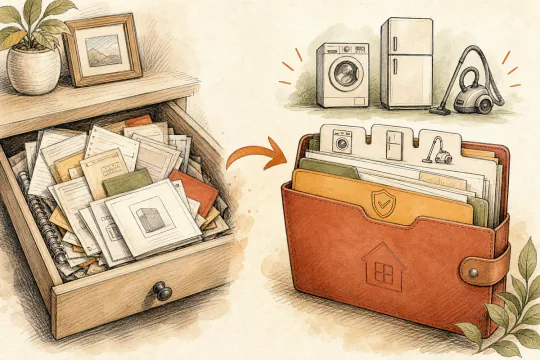
A calendar reminder says "call the technician". Homeward adds: when was the last check, how much did it cost, did the technician issue a report, when does the appliance warranty expire. The difference matters when the technician asks for the boiler's history and you can't find it. Homeward is in pre-launch — you can join the waitlist for free.
In practice the point is to make small losses visible faster: higher bill, overdue service, leak, equipment that's been working worse than it should for ages.
If you want to start with the lightest version of this tidying-up, a simple summer home reset is a good entry point — a few small repairs and checks before the costs grow another season.
A good starting point is keeping bills and invoices in one place — only then can you see which spending categories are growing and where to look for silent losses.
If you want to go beyond cosmetic savings, it's worth considering thermal modernisation — because sealing the home and replacing the heat source work the opposite way to silent costs: one upfront expense that cuts monthly losses for a decade.
Frequently asked questions
How much can silent home costs add up to per year?
Estimates depend on the technical condition of the home and its appliances. Standby mode: PLN 110–240, leaky taps and toilets: PLN 100–250, outdated appliances and lighting: PLN 200–600, sub-optimal electricity tariff: PLN 0–600. Total: PLN 600–1,700 a year is a realistic range for a home with several areas to improve.
Is it worth switching from G11 to G12 tariff?
It depends on your usage profile. G12 pays off if large appliances (heat pump, washing machine, dishwasher, EV charger) mostly run at night. For a typical flat without those appliances the difference may be small or negative. Check your provider's tariff calculator before switching — it's a matter of minutes.
How do I check if the toilet cistern leaks?
Pour a few drops of food colouring into the cistern tank. Wait 15–20 minutes without flushing. If colour appears in the bowl — the cistern leaks. Replacing the seal or mechanism costs PLN 15–50 and about 20 minutes of work.
Does an old fridge really cost that much?
A 2008 fridge typically uses 380–450 kWh per year. A new equivalent of the same capacity, class A: 100–150 kWh. The 300 kWh difference is PLN 255/year. With a 15-year lifespan on the new unit that's PLN 3,825 saved on electricity — before you add up the repairs and service of the older one.
How do I avoid putting off small repairs?
The most effective method is two annual walk-throughs before each season: spring (after winter, before summer storms) and autumn (before the heating season). Each walk-through: gutters, window seals, taps, visible plaster condition. Time: 30–45 minutes. Most small faults are caught before they grow into expensive repairs.
Checklist: how to catch silent home costs
- [ ] Switched power strips at the AV stack and the desk
- [ ] Cistern test (dye) — once a year
- [ ] Check every tap for drips — every six months
- [ ] Bulb review: are they all LED?
- [ ] Reviewed electricity tariff — does it match your usage profile?
- [ ] Heating equipment check scheduled before the season
- [ ] Walk-round on gutters and roof — after winter and after summer
- [ ] Window seals checked — before the heating season
- [ ] Invoices and bills in one place — so you can track spending trends