According to Statistics Poland, housing and energy accounted for 18.8% of all Polish household spending in 2024 (Statistics Poland, Household Budgets 2024, 2025). That's more than clothing, health and education combined. The home deserves its own budgeting system — not just a row in a spreadsheet.
Key takeaways
- Home costs split naturally into four rhythms: monthly, seasonal, yearly and emergency.
- 68% of Polish households are property owners (Statistics Poland, 2024), for whom cost control matters especially.
- An emergency fund should cover a minimum of 3–6 months of fixed home costs.
- One simple tool that ties the rhythms together eliminates the "expensive month" effect.
Why does a household budget need its own rhythm?
Housing and energy spending was 18.8% of Polish household spending in 2024 (Statistics Poland, Household Budgets 2024, 2025). That means the home isn't a small category in the budget. It's a separate system of costs, deadlines and documents that follows quite different logic than grocery shopping.
A home doesn't spend money evenly. Electricity returns every month. The policy returns once a year. Boiler service shows up before the season. A bathroom renovation enters the budget like a separate project, usually when no one expects it.
If all those expenses go into one bucket, every harder month looks like a budgeting failure. Often it isn't. It's simply several rhythms meeting in one month.
The key observation is this: Polish households usually control daily costs well but lose track of the rare ones. Policy, chimney inspection, property tax — these items don't return every week, so they're easy to miss in planning. That's why a separate rhythm is needed, not just a separate drawer.
How do you plan a household budget so costs stop surprising you?
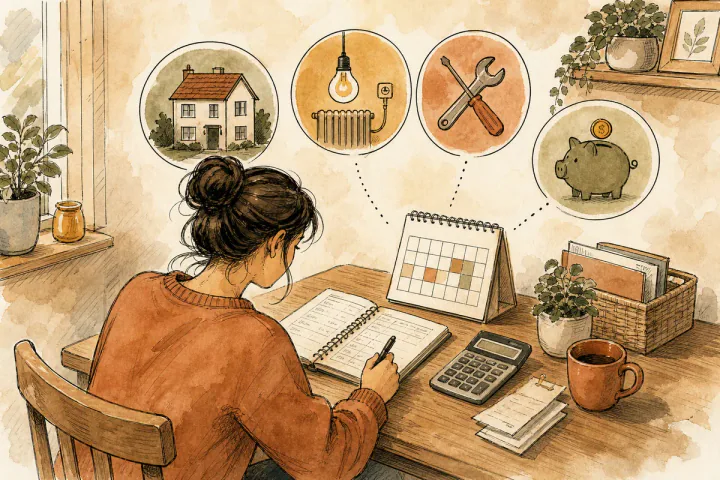
Statistics Poland shows that running a home and energy is one of the biggest items in Polish family spending (Statistics Poland, Household Budgets 2024, 2025). The simplest way to control them is to split into four rhythms: monthly, seasonal, yearly and emergency. Only then do you see which costs to pay and which to plan ahead.
| Cost rhythm | Examples | What to do |
|---|---|---|
| Monthly | electricity, gas, internet, rent/mortgage | set a control amount and watch deviations |
| Seasonal | heating, garden, AC, chimney inspection | plan 2–3 months ahead |
| Yearly | policy, property tax, big service | divide by 12 and set aside monthly |
| Emergency | plumber, appliance, leaking roof | keep a reserve outside the current account |
This split works because it doesn't mix fixed costs with emotional ones. A failure hurts less if it has its own envelope. A policy stresses less if it was visible for 12 months as a monthly savings instalment.
Example: the Kowalski family, net income PLN 6,500/month
The Polish statistical household with a median net income of around PLN 6,500 per month (Statistics Poland, 2024) spends more on home-related costs than it usually plans. The split below shows what the four rhythms look like in practice for such a budget.
Monthly rhythm (certain costs, returning every 30 days):
- Mortgage instalment or rent: PLN 2,200
- Electricity: ~PLN 250 (at average use 150–200 kWh/month)
- Gas: ~PLN 180 (outside the heating season)
- Internet and phone: PLN 120
- Housing community fund (for flats): PLN 80–150
Monthly rhythm total: ~PLN 2,800–2,900, i.e. 43–45% of income.
Seasonal rhythm (predictable but irregular costs):
- Chimney inspection (mandatory yearly): ~PLN 200
- Winter heating: extra PLN 300–500/month
- Pre-summer AC service: PLN 150–250
- Garden prep for spring or winter: PLN 200–400
Plan ~PLN 150–200 monthly as a seasonal buffer so December or March spikes don't sting.
Yearly rhythm (rare but big costs):
- Home or flat insurance: ~PLN 600–900/year
- Property tax: PLN 200–800/year (depending on size and municipality)
- Boiler or stove inspection: PLN 300–500
- Planned small repairs: PLN 500–1,000/year
At PLN 6,500 income that means ~PLN 200–260 monthly set aside to cover yearly costs. Without that plan those sums always "fall out of the budget".
How much for the home emergency fund?
According to Eurostat, unplanned home repair spending hits over 30% of European households every year (Eurostat, Housing conditions 2023, 2023). It's especially relevant in Poland because 68% of Poles live in their own property and bear the full cost of failures without a landlord (Statistics Poland, 2024, 2025).
What do typical failures really cost?
Not all failures are equal. Indicative costs of the most common situations:
- Gas boiler replacement: PLN 3,000–8,000 (depending on brand and model)
- Leaking roof repair: PLN 5,000–20,000 (partial or full)
- Washing machine or dishwasher failure: PLN 500–1,500 to repair, PLN 2,000–4,000 to replace
- Electrical installation replacement (section): PLN 1,500–5,000
- Burst pipe and flooding: PLN 2,000–15,000 depending on damage scope
An emergency fund equal to 3–6 months of fixed home costs is Poland's version of a financial "safety buffer". For the Kowalskis, whose fixed costs are ~PLN 2,800/month, that means a fund of PLN 8,400–16,800.
How to build the fund gradually?
You don't need the full amount immediately. Personal finance practitioners recommend starting with PLN 500–1,000 and adding a fixed amount each month, even PLN 200–300. The key is to keep this money in a separate account that's not "at hand". Goal: cover at least one serious failure without resorting to credit.
In practice the biggest problem isn't maths. Building the emergency fund is blocked by the belief that "it won't happen to us". Meanwhile the boiler doesn't ask about the timing, and the roof doesn't wait for a bonus.
How to implement the 4-rhythm budget in practice?
URE points out that energy bills rise not only because of higher prices, but also because of unconsciously increasing consumption (URE, Guide for Energy and Gas Consumers, 2026). A good home budgeting method has to account not only for amounts but also for dates and consumption. Here's one way that works without specialist software.
The four-account (or four-envelope) method
The simplest implementation is four separate "places" for home money. They can be sub-accounts in a bank, separate lines in a spreadsheet, or physical envelopes.
How it works step by step:
- Monthly account — electricity, gas, rent/mortgage land here. Each month compare with the previous one.
- Seasonal account — transfer a fixed sum every month (e.g. PLN 150). In October you have somewhere to pay for the chimney inspection and the first heating bills.
- Yearly account — divide the sum of yearly costs by 12. E.g. policy PLN 720 + tax PLN 480 + boiler service PLN 400 = PLN 1,600 / 12 = ~PLN 133/month.
- Emergency fund — a separate account you only touch in a real failure. Goal: minimum PLN 8,000.
This split means "the expensive October" stops existing. Each month has the same structure, and rare costs don't fall out of the plan.
Percentage structure for a household budget
At a net income of PLN 6,500, a sensible split for home costs looks like this:
| Category | % of budget | Average PLN (at PLN 6,500) |
|---|---|---|
| Mortgage instalment or rent | 30–35% | PLN 1,950–2,275 |
| Utilities (electricity, gas, water) | 6–8% | PLN 390–520 |
| Internet, phone, TV | 2–3% | PLN 130–195 |
| Seasonal fund | 2–3% | PLN 130–195 |
| Yearly fund (policies, taxes) | 2–3% | PLN 130–195 |
| Emergency fund | 3–5% | PLN 195–325 |
| Community fee (if applicable) | 1–2% | PLN 65–130 |
Total: ~46–59% of net income, in line with Statistics Poland data on Polish household spending structure (Statistics Poland, Household Budgets 2024, 2025).

How do you use bill history instead of guessing?
URE emphasises that fully understanding the energy bill — including the breakdown of charges and consumption — is the foundation of conscious cost management (URE, 2026). Three electricity bills from different times of year say more about your home than a year of noting small purchases.
Gather the history. The last three electricity bills. The most recent policy. Boiler service cost. Repair invoices. Receipts for appliances under warranty.
Then label each cost: monthly, seasonal, yearly or emergency. After an hour's work you'll see your home financially, probably for the first time.
What to look for in cost history:
- Seasonal spikes in gas and electricity bills (January–March vs. July–September)
- One-off costs that really return every year in another form
- Services and subscriptions you pay without realising (old contracts, forgotten services)
- Repairs that signalled a problem earlier but weren't recorded
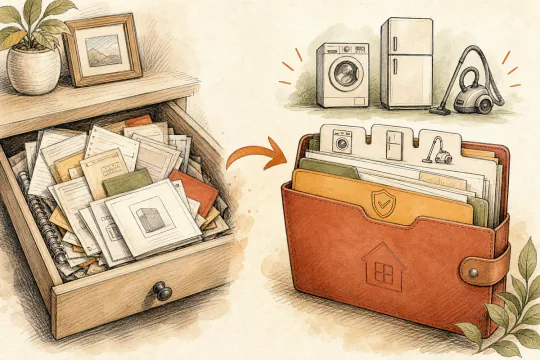
If you want to gather these documents in one place, start with the post on how to handle invoices and home documents.
How to start a household budget in the first 30 days?
The first 30 days of a household budget should serve to organise data, not tighten the belt. Behavioural economics shows that simply tracking spending changes financial habits — without any extra intervention. The home is no exception.
- Gather bills and fixed payments from the last 3 months.
- Add yearly costs: policies, taxes, inspections, subscriptions.
- Mark seasonal costs: heating, garden, AC, winter prep.
- Open a separate sub-account or envelope for the emergency fund, even if symbolic at the start.
- Set reminders 14–30 days before the deadline, not on the payment day.
Household budgets usually don't lack maths. They lack memory. When documents lie in drawers and deadlines live in your head, the budget becomes heavier than it should be. We design Homeward for exactly that problem: bills, invoices, inspection dates and policies in one place — so in the first days of the month you see the full cost picture rather than discovering it piece by piece. Homeward is in pre-launch — you can join the waitlist for free.
If you want to go deeper into optimising one of the biggest items, see the guide on cutting electricity bills. Worth checking too which silent home costs often slip planning.
Citation: Housing and energy spending was 18.8% of Polish household spending in 2024 (Statistics Poland, Household Budgets 2024, 2025). Splitting these costs into monthly, seasonal, yearly and emergency rhythms lets you avoid the "expensive month" effect and plan an emergency fund for typical home failures in the PLN 3,000–20,000 range.
FAQ
According to Statistics Poland, housing and energy are among the two largest categories of Polish household spending (Statistics Poland, Household Budgets 2024, 2025). The questions below concern concrete Polish reality: PLN, Polish law and typical costs.
How much to set aside monthly for yearly home costs?
Divide the sum of your yearly costs by 12. A typical set for a flat (policy ~PLN 700 + tax ~PLN 400 + boiler service PLN 400) gives ~PLN 125/month. For a single-family home, with a bigger property tax and more inspections, a realistic amount is PLN 200–300/month.
How big should the home emergency fund be?
The home emergency fund should cover at least one major failure. A boiler replacement is PLN 3,000–8,000, a roof repair PLN 5,000–20,000. Polish personal finance standards talk about 3–6 monthly instalments of fixed home costs, which for an average family means PLN 8,000–15,000 set aside in a separate account.
Do I have to track every receipt?
No. In the home budget, recurring and large costs matter more than daily grocery shopping. Receipts are worth keeping when they involve a warranty, complaint, renovation or a specific appliance. The rest you can track at the category level, not per purchase.
What's included in home costs for flats in a community?
Flat owners pay a community fee that covers a renovation fund, common-parts charges and often property management. A typical renovation fund is PLN 5–15/m²/month. For a 60 m² flat that's PLN 300–900/month — a significant item in the home budget, often skipped in planning.
How often to update the home budget?
Once a month is enough to control current costs. Once a quarter check policies, tariffs, subscriptions and planned inspections. Once a year compare costs with the previous year to see whether seasonal and yearly spending fits the plan.
Policy and home insurance deadlines are covered in a separate post: how not to miss a policy expiry.