Key takeaways
- A gap in motor third-party (OC) cover risks a UFG control fee of about PLN 9,332 — for the simple fact of no policy, without any claim (UFG, 2025).
- A new policy after a gap costs on average 15–25% more than an on-time renewal — and you also lose your no-claims discount (Rankomat.pl, 2024).
- An average Polish household has 3–5 policies and recurring contracts whose dates expire in different months.
- One simple reminder system is enough for these problems to stop existing.
This happens to perfectly organised people
You know how it goes. The policy is there, it was, it's definitely somewhere. A year ago it renewed automatically. Or you renewed it yourself — you remember filling something in. Either way, everything's fine.
And then it turns out the reminder from the insurer arrived by post in August, while you were on holiday. The email went to spam. And a week passed from the expiry date before you noticed.
The people who fall into this trap aren't disorganised — they're the ones with a lot on their minds: work, kids, renovations, holidays. A policy doesn't shout. There's no big banner with a number. It quietly expires, while you live on, convinced that you're insured.
One of the most frequent themes in conversations with Polish homeowners while designing Homeward sounded roughly like this: "I knew I had the date somewhere but I couldn't remember where". From exactly that scatter of dates grew one of Homeward's foundations: one timeline for policies, inspections and warranties, instead of memory split between an inbox, paperwork and your head.

What do we have to keep an eye on in Poland?
Before we get to solutions, let's see how many of these dates there actually are. The Polish Insurance Association's statistics show that the vast majority of Polish households with a car hold at least one motor policy, and more than half also insure their property (PIU, Yearbook 2024). On top of that there are life policies, personal accident insurance, vehicle technical inspections and mandatory building inspections.
And that's just policies. On top of that come things we less often think of as "insurance", but which also have valid-to dates:
Car:
- Technical inspection — every year for cars older than 3 years, every 2 years for newer
Home or flat:
- Gas installation inspection — mandatory every year under the Construction Law
- Chimney inspection — every year
- Manufacturer's warranty on appliances — 2 to 5 years from purchase
Add it all up and you have 5 to 8 dates a year, scattered randomly across the calendar, across different places and providers. None of it is hard — but without a single place where it all lives, every one of those dates has a chance to surprise you.
What happens when a policy expires?
Two scenarios. Both unpleasant, though to very different degrees.
The mild version: you notice within a week, nothing bad happened. You call the insurer or look for a new offer. But there's a surprise waiting: a new policy after a gap costs more. Insurers treat a break as a risk signal. You lose continuity and no-claims discounts you built up over years. For motor OC that usually means 15–25% higher premiums (Rankomat.pl, 2024). For comprehensive (AC) on a newer car — several hundred zlotys of difference a year.
The costly version: before you notice, something unplanned happens. With motor OC, no mandatory cover means a control fee from UFG (the Insurance Guarantee Fund). In 2025 for a passenger car that's the equivalent of two minimum wages gross — about PLN 9,332. Critically: this fee is charged for the simple fact of no policy, regardless of whether you caused any damage (UFG, 2025).
There's no formal penalty for no home insurance. But a flood, fire or storm without cover is your bill in full. For a flat or detached house — easily tens of thousands of zlotys.
There's something non-obvious here: it's not the motor OC expiry that's the biggest problem — we track that, because we know it's mandatory. The problematic ones are the "important but not immediate" deadlines: home insurance, gas inspection, the boiler warranty. Those slip through the cracks of our memory.
A gap in motor OC results in a UFG control fee of about PLN 9,332 for a passenger car in 2025 — and it's charged automatically for every day without a valid policy, regardless of whether the driver caused any damage (UFG, 2025). It applies to every vehicle owner, even when the car is in the garage.
How to get a grip on deadlines before deadlines get a grip on you?
This isn't a complicated problem. It needs one system — not five.
Step 1: Gather all documents in one place.
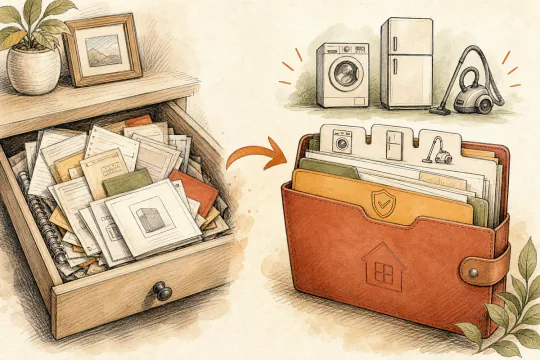
A scan or photo of every policy, the registration certificate, gas inspection confirmation, receipts with warranty dates. One location — folder on disk, app, or even a plastic file — and one point you check when you need something. How to build such a system for your entire home financial documentation is a separate article.
Step 2: Put expiry dates in a single calendar.
Set two reminders: 30 days before the date and 7 days before. The first gives you time to compare offers. The second is the last signal before expiry. One place — not scattered across phone, laptop and sticky notes.
This is exactly the kind of problem Homeward is meant to take off a homeowner's shoulders: not just store the date, but link it to the document, the scope of cover and a reminder set in advance — so in August, before holiday's over, you already know that October requires a decision. Homeward is in pre-launch — you can join the waitlist for free.
Step 3: Compare offers ahead of time, not on the day of expiry.
At automatic renewal, insurers often raise the premium counting on customer inertia. Comparison sites (Rankomat, Mubi, Beesafe) let you check in 10–15 minutes whether you have a good price. For motor OC or home insurance, it's worth doing once a year.
Step 4: Keep an offline copy of the policy.
A PDF on your phone or a photo in the camera roll. After a fender-bender or a gas installation failure, there isn't always time and signal to dig through email.

How do you compare motor OC offers before renewal?
The Polish motor insurance market is competitive. According to PIU, the average motor OC premium in 2023 was around PLN 575 per year, but the spread between the cheapest and most expensive offer for the same driver can reach 40–60% (PIU, Yearbook 2024). So checking the market is worth it — but worth doing wisely, not on the last day.
Comparison sites all work similarly: you give vehicle data, claim history and a few personal parameters, and the site shows a dozen insurers' offers at once. In Poland three platforms dominate: Rankomat, Mubi and Beesafe. Each has its own agreements with insurers, so results may differ slightly. Checking two of them is enough for a full picture.
What to check before you click "buy":
Guarantee sum. The minimum OC sum required in Poland is EUR 1.34 million for personal injury and EUR 1.22 million for property damage per event (UFG, 2025). Every offer should meet this threshold by law — but it's worth confirming, especially on very cheap proposals.
Territorial scope. Polish motor OC standardly covers the entire European Economic Area (EEA). If you drive outside the EEA, check whether you need an additional Green Card — and whether the insurer issues one.
Termination terms at automatic renewal. Some insurers renew the policy automatically and issue a debit note. You have the right to terminate that contract within 30 days of conclusion. But the date that counts is the conclusion date, not the date of receipt. Check the terms before purchase.
Add-ons: assistance and personal accident. Roadside assistance and personal accident (NNW) are separate products that often come bundled with OC. The premium difference is small while the scope of cover grows noticeably.
What does this look like in practice? Thirty minutes at the computer, three comparison sites, a few tabs. That's enough not to pay PLN 200–400 too much for the same cover.
The premium spread for motor OC for the same driver across different insurers in Poland reaches 40–60% of the policy value — at an average premium of PLN 575/year that's potential savings of PLN 200–345 with no change in cover scope (PIU, Yearbook 2024).
When is it not worth chasing the cheapest OC?
Price isn't the only criterion. If you've had a claim-free history with one insurer for years, your claims history is one of the assets worth protecting. Switching insurer mid-streak can, on the next claim, complicate the transfer of your history. Ask the new insurer directly: do you honour the no-claims discount from the previous TU, and in what form do you need the confirmation?
Frequently asked questions
Does my insurer have to remind me of my motor policy's expiry?
Yes — for motor third-party (OC) the insurer is required to send notice of an approaching expiry. But if the letter went to an outdated address or the email landed in spam, the responsibility for continuous cover still rests with the vehicle owner. Track deadlines yourself, regardless of the insurer's reminders.
What's the penalty for no motor OC in 2025?
In 2025 the UFG control fee for missing motor OC on a passenger car is the equivalent of two minimum wages gross, about PLN 9,332. It is charged for every day of uninsured driving and doesn't depend on whether you caused any damage. For a tractor or bus the rate is even higher (UFG, 2025).
Is home insurance mandatory?
No — in Poland home or flat insurance is not mandatory (unlike motor OC). It is, however, required by banks for mortgages and provides the basic financial cover for water damage, fire or storm. A flat policy in a tenement block usually costs PLN 300–700 a year. It's worth checking whether your policy really protects you — scope and sum insured matter enormously at the claim.
What do I lose if I don't renew on time?
Mostly your continuity and no-claims discounts. Insurers treat a gap as a sign of higher risk and offer higher premiums or worse terms. With a multi-year claim-free history this can mean PLN 200–500 more per year on the new policy (Rankomat.pl, 2024).
How often should I review my policies?
Once a year, at renewal, is enough. Check whether the sum insured still matches your property or vehicle value and compare the current offer against the market. Major life changes — a move, a new car, a renovation — are additional moments worth a review.
Checklist: what to review once a year
- [ ] Motor OC — when does it expire, worth comparing offers?
- [ ] Comprehensive / personal accident — do the terms match the vehicle's current value?
- [ ] Home or flat insurance — is the sum insured up to date?
- [ ] Vehicle technical inspection — expiry date
- [ ] Gas installation inspection — year of last check (mandatory yearly)
- [ ] Chimney inspection — year of last check
- [ ] Appliance warranties — what's still under warranty?
- [ ] Life or personal accident policy — does the cover still match your situation?