Key takeaways
- Polish homes use an average of 26 GJ of energy per year, and heating accounts for around 70% of that — every missed boiler reading is a real loss (Statistics Poland, household energy use 2021, 2023).
- A calm morning is made in the evening: things, documents and home deadlines should have their place before you walk into the bedroom.
- A daily "home walk-round" — 5 checkpoints in the morning — catches faults before they grow into expensive failures.
- The CDC recommends at least 7 hours of sleep, and the NIH points to daylight as the main signal of the circadian rhythm. The home should support both.
If autumn surfaces a backlog at home, see the winter preparations and home walk-through.
A morning starts from a place. Not from discipline, not from a 5:30 alarm, not from a perfect to-do list. From whether the home cooperates with the person who lives in it, or works against them.
According to Statistics Poland, a Polish household uses an average of 26 GJ of energy per year, of which heating accounts for about 70% (Statistics Poland, household energy use 2021, 2023). That figure rises when the boiler runs inefficiently, when ventilation is clogged or when window seals haven't been refreshed for months. None of these problems surfaces on its own. You have to reach for them.
The CDC recommends at least 7 hours of sleep per night for adults (CDC, 2024). A morning that starts with chaotic searching, with the question "does something important expire today", with the feeling that the home has a backlog — takes those hours back. A morning routine isn't a lifestyle luxury. It's a home-management tool.

Why does a calm morning start the previous evening?
The CDC emphasises that regularity of the circadian rhythm matters more than one-off effort (CDC, 2024). If the last 30 minutes of the day are eaten by home backlogs, document searches and unopened bills, sleep quality drops. The morning starts in the evening. There's no other way.
A morning is rarely ruined by one big catastrophe. More often by five trivial things at once. Where are the keys? Is the electricity bill paid? Is the technician coming today? When does the fridge warranty end? Each of those weighs nothing on its own. Together they block the start of the day.
A calm routine doesn't have to be aesthetic. It has to be robust. Things by the door. One list. Home deadlines outside the head. That's enough.
The biggest relief doesn't come from a perfect routine. It comes from the feeling that the home isn't waiting in hiding with overdue business. An evening on which you check whether anything expires this week is a morning on which you don't have to.
What is the morning home walk-round and how long does it take?
A Polish residential building is subject to a mandatory chimney sweep inspection at least once a year, under the Construction Law (Art. 62(1)(1c)). But the daily minimum — checking ventilation pull, boiler pressure and window seals — takes 4 minutes and needs no tools. That's the difference between reacting to failures and preventing them.
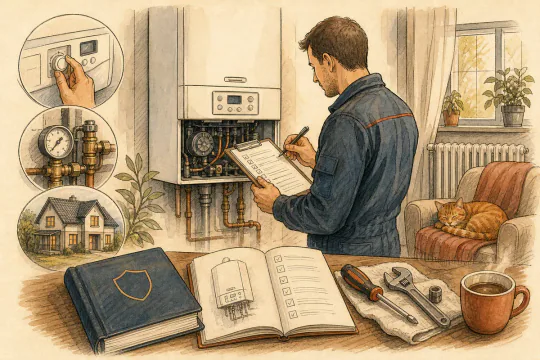
The morning walk-round is a short, repeatable ritual. Not a technical inspection. Five checkpoints a homeowner or flat owner can check by eye and touch before leaving for work.
5 things to check every morning
1. Boiler pressure (30 seconds)
Correct working pressure in central heating is 1.5–2.0 bar. If the gauge shows below 1.0 bar, the system is losing water. Many Polish boilers don't alarm for this — the owner doesn't know until the boiler shuts itself off. A glance at the pressure gauge on the way to make coffee is enough.
2. Ventilation (30 seconds)
The ventilation grille should have a perceptible pull. A simple test: a sheet of paper held to the grille should gently move. Blocked ventilation means damp, mould and rising CO2 in the bedroom. According to the General Office of Building Supervision, ventilation duct blockage is among the most commonly identified faults in Polish buildings (GINB, Report on the technical condition of building resources, 2022).
3. Thermometer and thermostat (20 seconds)
Does the room temperature match the thermostat setting? A difference of more than 2 degrees suggests the radiator isn't drawing heat — the cause is often banal: a closed valve or a need to bleed. In winter, an under-heating room is a signal worth catching in the morning, not after a week.
4. Windows and seals in the winter season (30 seconds)
In October and March condensation on panes is normal. But a wet window sill, damp on the wall beneath, or a noticeable draught around the frame is a fault, not a phenomenon. A window seal costs a few zlotys. A new window — several thousand.
5. Water (20 seconds)
Any sign of a leak under the sink, under the washing machine, by the toilet? A small leak at the cistern seal wastes up to 200 litres a day and pushes the bill up before you notice.
| Checkpoint | Time | Benefit for the home |
|---|---|---|
| Boiler pressure | 30 sec | Avoid a sudden heating shutdown |
| Ventilation | 30 sec | Lower damp and CO2 |
| Thermostat vs. temperature | 20 sec | Detect blocked radiators |
| Window seals (seasonal) | 30 sec | Prevent heat loss |
| Leak traces | 20 sec | Save water and avoid flooding |
| Total | ~2.5 min | Prevention instead of repair |
What should come first: phone or light?
The NIH explains that the circadian rhythm responds directly to light signals: morning exposure to bright light speeds waking and improves concentration through the day (NIH/NIGMS, 2024). Reaching for the phone before first looking out of the window reverses that sequence. Other people's business enters the home before the home itself has woken up.
It's not about banning anything. It's about order.
First raise the blind or roller shutter. Do it before you leave the bedroom. The window isn't just a view — it's a regulator of the circadian rhythm, the indoor climate and a natural weather indicator that tells you whether to air the room. Drink water. Look outside. Only then check messages.
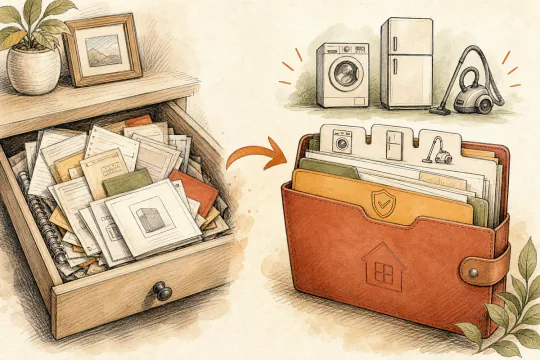
The morning is calmer when the home doesn't have to act as command centre. If everything important — policies, bills, deadlines, warranties — lives in several different places at once, every morning starts with an unplanned audit. One point, one list, one glance. That's a structural change, not a motivational one.
How to prep the home in 12 minutes in the evening?
Healthy sleep habits — including reducing stimulation before sleep and keeping regularity — translate into deeper sleep and easier mornings (CDC, 2024). The evening home reset should be short, concrete and always the same. It can't turn into a second shift of work.
Four steps that work:
- Put keys, wallet and going-out items in one fixed place.
- Write down one most important thing for tomorrow. One, not five.
- Check whether the home has an urgent deadline within the next 7 days: payment, service, document, expiring warranty.
- Dim the lights 30–60 minutes before sleep, if you can.
Step three sounds simple. In practice it's the hardest, because home deadlines are scattered across drawers, emails, banking apps and memory. An evening with Homeward turns this step from a search into one glance: inspection dates, expiring warranties, upcoming payments — all in one place before you go to bed. Homeward is in pre-launch — you can join the waitlist for free. If you don't have a single place for documents, start with order in invoices and receipts. It's also worth reading about which home costs regularly slip out of sight before they become urgent expenses.

How do you take home chores out of your head?
The NIH describes the circadian rhythm as a biological system steered by regular external signals (NIH/NIGMS, 2024). The home works similarly: it responds to regular cycles of checks, maintenance and payments. When those cycles aren't predictable, the owner wakes up each morning with an unconscious question: "what did I miss?"
In the morning you don't want to recreate the home's history. You want to know one thing: does anything need attention today.
Thermostats have schedules. Boilers have inspections. Policies have deadlines. Warranties expire. Polish electricity bills have grown for three years running, and managing consumption starts with knowledge, not impulse (URE, electricity prices report, 2024). When that information lives in one place, the morning is several decision-minutes shorter.
A morning routine in a home with children: what it really looks like
Homes with children have their own morning rhythm. According to Statistics Poland, almost 40% of Polish households are families with at least one child under 18 (Statistics Poland, Demographic Yearbook 2024, 2024). For these families the classic "minimum morning routine" needs adjustment. Not because the rules differ, but because the margin for error is smaller.
With children, the morning has two problems at once. First: more variables you don't control. The child who won't get up, mismatched socks, the lunch forgotten on the way out. Second: less time for yourself to think about the home as a whole.
In conversations with parents while designing Homeward one thread kept returning: "I don't have time in the morning to think about bills, inspections or policies. I see it in the evening, when the kids are in bed — and by then it's too late to do anything about it." A morning routine with children has to be shorter and more mechanical. Fewer decisions in the morning, more preparation in the evening.
The minimal version of a morning routine with children has four points:
Point 1: Fixed places for things. Backpack, shoes and the child's jacket always in the same place. Parent's keys and wallet always in the same place. Deciding the place is a one-off cost. Not searching in the morning is a daily time saving.
Point 2: Clothes ready the night before. Evening prep of clothes for the child takes 2 minutes. Morning search for a matching sock takes 10 minutes and ends in stress for everyone. For children under 7–8: prep together in the evening, give them agency. For older ones: set a rule that they pick in the evening themselves.
Point 3: One glance at the home plan. Not reviewing all deadlines. One question: "is anything important today?" Bill to pay? Technician in the morning? An expiring policy date? If that information is in one place, this takes 20 seconds. If scattered across email and head, it takes 10 minutes or doesn't happen at all.
Point 4: Accepting chaos as the norm. A morning with children won't be calm in the meditative sense. The goal is different: predictable rather than calm. When everyone knows what follows what, the chaos has a frame. The frame doesn't eliminate the noise, but it eliminates the feeling that everything is falling apart.
Worth noting one thing: formal home obligations — deadlines, documents, bills — shouldn't enter the morning space with children. That's an evening task, when the kids are asleep. If you have one place for all home deadlines, checking it in the evening takes 2 minutes. Without that place, every morning is an opportunity to forget something important.
What to do when the morning falls apart anyway?
The CDC emphasises that sleep and wake routines work by accumulation, and a single bad night doesn't cancel the whole rhythm (CDC, 2024). Mornings work exactly the same. The routine is meant to be a comeback plan, not a character test.
Have a minimum version. Four elements you can always do:
- Open the curtain. A moment of natural light.
- Drink a glass of water before you reach for coffee.
- One glance at the day's list. One thing.
- Thirty seconds on the boiler pressure gauge or the ventilation grille.
With children, illness or an intense week, shorten the ritual. Don't delete it. Two minutes of attention beats another day started with chaos that piles up into a week's worth of home backlog.
FAQ
According to Statistics Poland, a Polish household spends on average 14–18% of its budget on energy and property maintenance (Statistics Poland, household budgets, 2024). Morning home management is in practice managing that spend, before it slips out of control.
Is a calm morning realistic with children?
Yes, but the routine has to be simpler. In a home with children the minimum rule works: a fixed place for keys and documents, clothes ready in the evening, one list. Not an ideal schedule — repeatable anchor points. A morning with children doesn't have to be calm. It has to be predictable.
How long should a household morning routine take?
15–20 minutes is enough in total, of which the home walk-round takes 2–3 minutes. Repeatability matters more than duration. A daily 3 minutes at the boiler and ventilation is 18 hours a year that can prevent a failure costing thousands of zlotys.
What to check in the home in winter vs. summer?
In winter the priority is heating: boiler pressure, window tightness, ventilation blockage. In summer — mechanical ventilation, AC and damp traces after rain. In spring and autumn it's worth checking gutters and drainage around the building. Detailed seasonal checklists are in the article on winter preparations.
How often do you really need to check boiler pressure?
A daily look at the gauge takes 10 seconds. Most technicians recommend an active weekly check in the heating season and once a month outside it. If pressure drops faster than 0.2 bar per week, the system probably has a leak that needs diagnosis — not endless water top-ups.
How does Homeward help with daily home management?
Homeward moves remembering about the home outside your head. Policy, warranty, inspection and bill deadlines are in one place, not scattered across the inbox, drawers and memory. The morning doesn't have to start with an audit. One look is enough to know whether anything needs attention this week.